
What Is Ataraxia? Inner Calm as a Trained Skill, Not a Mood
Ataraxia, the ancient Greek state of untroubled stillness, was named as the highest goal by three rival philosophical schools that agreed on almost nothing else. Most men mistake it for a mood that visits on good days or for emotional numbness. It is neither. This guide breaks down what ataraxia…
Contents
- The Basics: What Ataraxia Actually Means
- Why Three Rival Schools Chose the Same Goal
- Ataraxia Is a Skill, Not a Mood
- Concrete Examples: What Ataraxia Looks Like Under Pressure
- Common Misconceptions About Ataraxia
- Ataraxia Versus Related Concepts
- Training Ataraxia: A Practical Framework
- Ataraxia, Masculinity, and Presence
- The Long Game: Ataraxia and What You Leave Behind
- Summary
Ataraxia is a state of untroubled stillness of mind, a freedom from anxiety that the ancient Greek philosophers treated as the highest condition a person could reach. It is not numbness and not detachment from life. It is the absence of internal turbulence while you remain fully engaged with the world.
Most men encounter the idea as a vague promise of “inner peace” and file it under things that happen to monks. That framing kills it. Ataraxia was never a mood that visits you on a good weekend. The Greeks described it as an outcome, the predictable result of a specific way of thinking that you practice until it becomes automatic. The Stoics, the Epicureans, and the Skeptics disagreed on almost everything else, yet all three named ataraxia as the destination. That consensus across rival schools is worth your attention.
The Basics: What Ataraxia Actually Means
Before the philosophy, the definitions. The word carries specific baggage that gets lost in modern translation.
| Item | Detail |
|---|---|
| Term | Ataraxia |
| Greek | ἀταραξία, from a- (without) + tarassein (to disturb, to stir up) |
| Literal sense | Unperturbedness, the state of not being stirred |
| Field | Hellenistic ethics, practical philosophy, psychology of emotion |
| Related concepts | Apatheia, eudaimonia, aponia, equanimity, prohairesis |
| Opposing concepts | Tarachē (turmoil), pathos (passion as disturbance), anxiety, reactivity |
| Why it matters | Named as the goal by Stoics, Epicureans, and Skeptics alike |
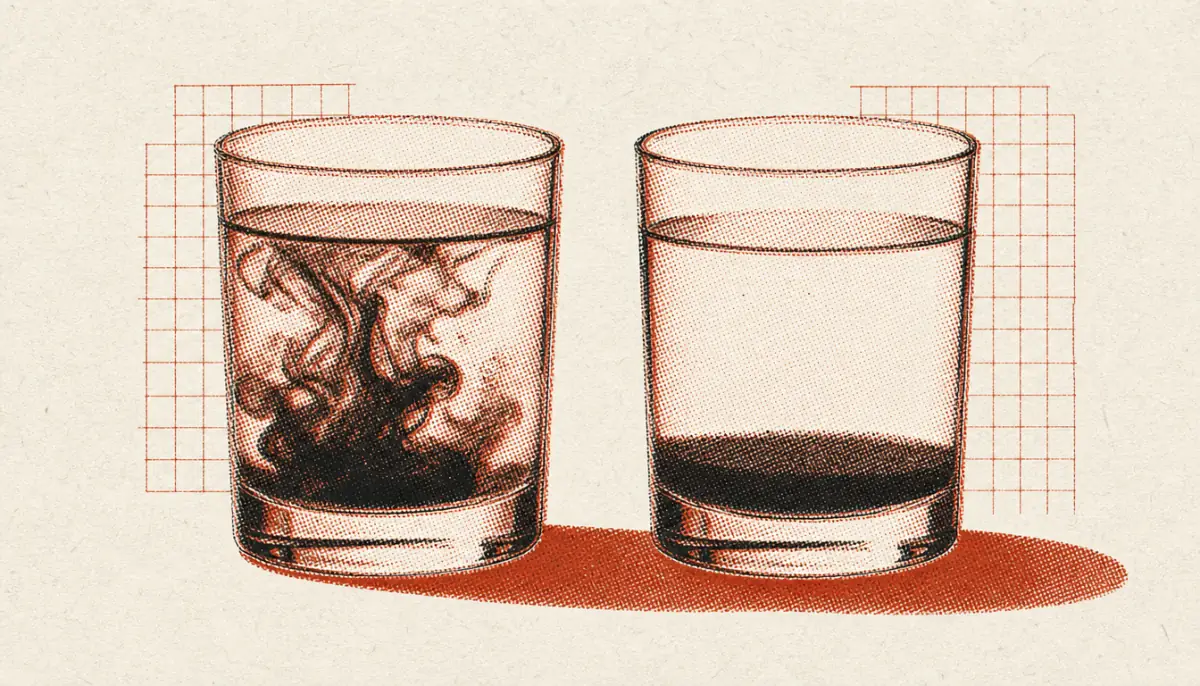
The etymology does heavy lifting here. Tarassein is the verb for stirring up sediment in water, or for throwing an army into disorder. Ataraxia is the water after the sediment settles. Nothing has been removed from the glass. The contents have simply stopped churning, and now you can see through them.
That image matters because it corrects the most common misreading. Ataraxia does not mean you have fewer experiences, fewer relationships, or fewer ambitions. It means those things stop kicking up silt every time they move.
Why Three Rival Schools Chose the Same Goal

Hellenistic philosophy was competitive. The Stoics and Epicureans argued over physics, pleasure, the gods, and the structure of the universe. The Skeptics attacked both for claiming to know anything at all. Yet when each school described the good life, they landed on the same word.
Their reasoning diverged completely, and the differences reveal three distinct paths to the same summit.
The Stoic Route: Judgment
The Stoics argued that disturbance comes from judgment, not from events. A man loses his job. The event is a change in employment. The turmoil comes from the judgment layered on top: this is a catastrophe, I am finished, everyone will see me as a failure. Strip the judgment and the event remains, workable and finite.
Epictetus built his entire teaching on the distinction between what is up to you and what is not. Your judgments, intentions, and responses belong to you. Reputation, health, wealth, and the behavior of other people do not. Disturbance is what happens when you stake your peace on territory you do not control. The Stoic reaches ataraxia by relocating his stake.
The Epicurean Route: Desire
Epicurus attacked the problem from the demand side. He sorted desires into three categories: natural and necessary (food, shelter, friendship), natural but unnecessary (rich food, luxury), and empty (fame, unlimited wealth, status over others).
The empty desires have no ceiling. There is no amount of status that satisfies the hunger for status, because the target moves with every acquisition. A man who has organized his life around empty desires has built a machine that manufactures disturbance permanently. Epicurus prescribed pruning the desire set down to what can actually be satisfied, which produces both aponia (absence of bodily pain) and ataraxia.
The Skeptic Route: Suspension
Pyrrho and his successors noticed that much human misery comes from dogmatic certainty about things that are not certain. Convinced that a specific outcome is good and its opposite is bad, a man tortures himself chasing one and fleeing the other. The Skeptics practiced epochē, suspension of judgment on matters that cannot be settled, and reported that ataraxia followed the suspension like a shadow.
Sextus Empiricus told the story of the painter Apelles, who could not render the foam on a horse’s mouth. Frustrated, he threw his sponge at the canvas, and the smear produced exactly the effect he had failed to paint deliberately. The Skeptics claimed ataraxia arrives the same way: not by direct assault, but as a byproduct of stopping the fight.
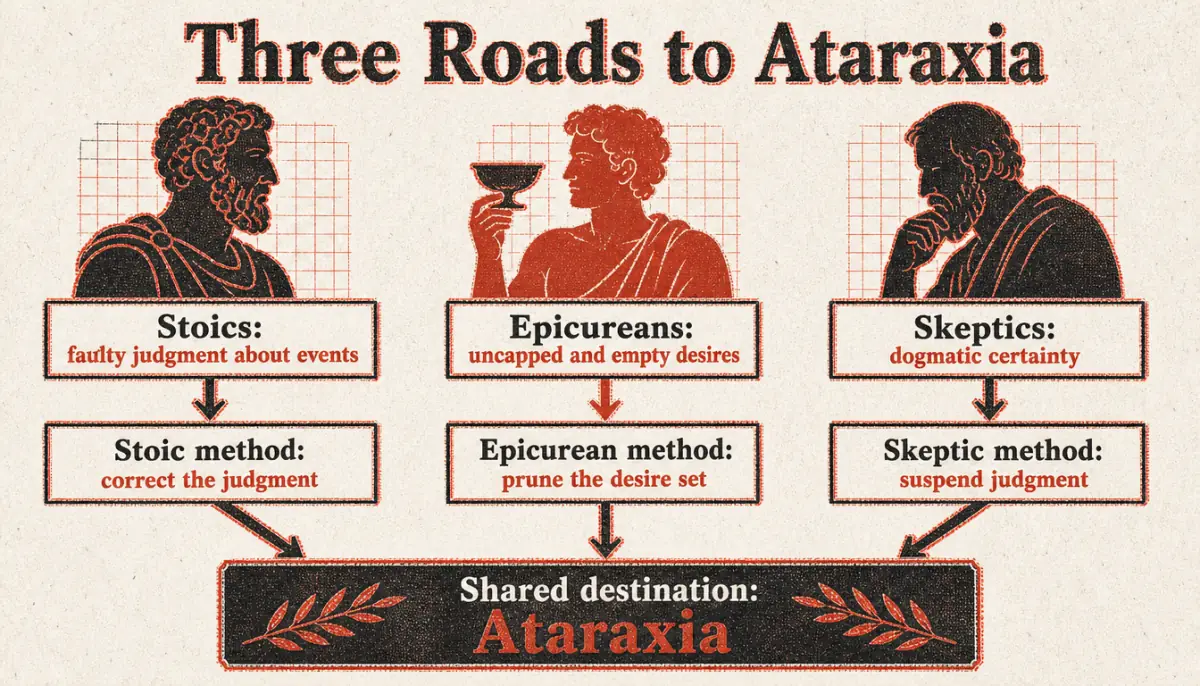
The diagram below maps how each school reaches the same destination from a different starting problem.
Ataraxia Is a Skill, Not a Mood
The practical claim buried in all three accounts is that ataraxia is trainable. Moods arrive and depart on their own schedule. Skills respond to repetition under load.
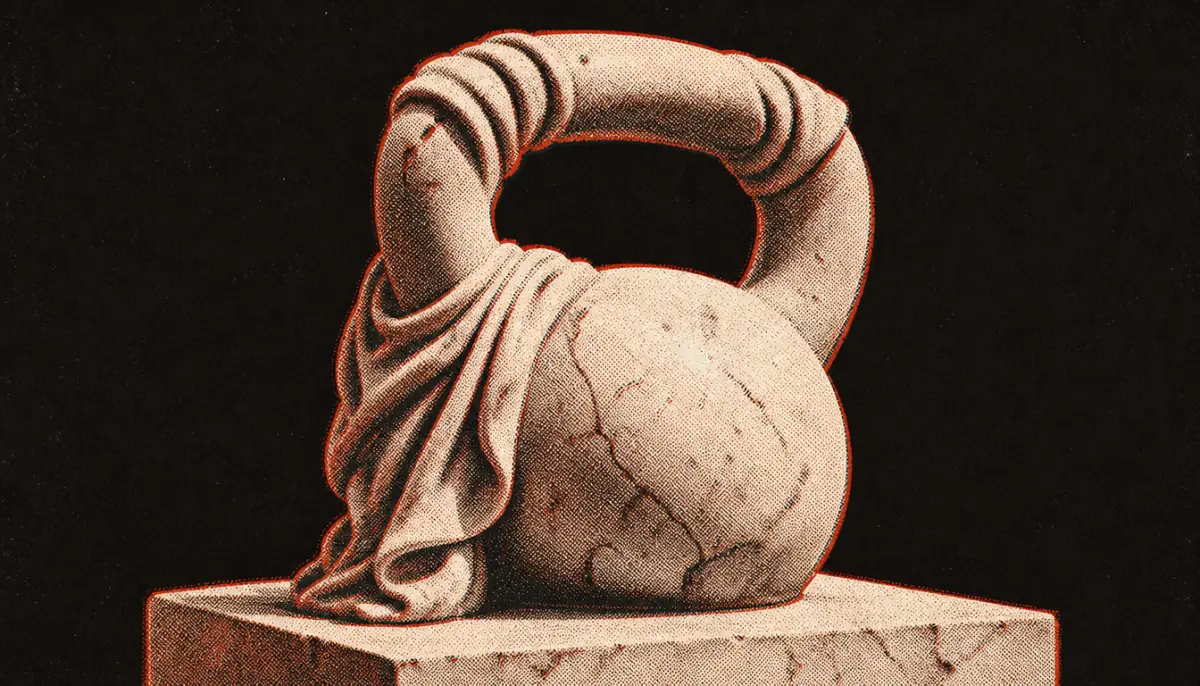
Consider how you already treat physical capacity. You do not expect to feel strong on a given Tuesday. You expect to be strong because you have loaded the movement for months. Nobody accuses a deadlift of being a feeling. The same logic applies to your response under provocation, and the Greeks knew it. Epictetus described philosophy students as athletes in training, and he was not being poetic. He meant that the response to an insult is a rep, and that you either train it or you do not.
This reframe has teeth because it kills the most common excuse. If ataraxia is a mood, then failing to have it is bad luck or bad brain chemistry. If ataraxia is a skill, then failing to have it means you have not trained, and training is available to you starting today.
What Training Looks Like Structurally
Every skill has a load, a rep, and a progression. Ataraxia is no exception.
- The load is any event that disturbs you. Criticism, delay, loss, physical discomfort, someone else’s incompetence.
- The rep is the gap between the event and your response, and what you do inside that gap.
- The progression is heavier load with the same quality of response, or the same load with a shorter recovery.
A man who cannot absorb a mildly critical email has no business attempting to absorb a failed venture. Load management applies. The Stoics understood this and recommended starting with minor irritations deliberately, which is why Seneca practiced voluntary discomfort on a schedule rather than waiting for real hardship to test him.
Concrete Examples: What Ataraxia Looks Like Under Pressure

Abstraction is where most philosophy dies. Here are three situations a man in his thirties actually encounters, with the disturbed response and the ataraxic response side by side.
Example 1: Public Criticism at Work
Your work gets torn apart in a meeting, in front of people whose opinion you care about.
The disturbed response starts before you speak. Heat in the chest, a rehearsal of counterarguments, an immediate scan of the room to see who witnessed it. You defend, or you go silent and defend for three days in your head. The criticism may have been accurate, but you cannot access that question because you are busy managing your standing.
The ataraxic response separates two things: the quality of the work, which is a technical question with an answer, and your standing in the room, which is not up to you. You ask a clarifying question. You take the accurate part and discard the rest. The absence of defensive heat is not suppression. It is the result of having already decided, long before this meeting, that your self-assessment is not outsourced to a conference room.
Example 2: A Plan Collapses
A deal falls through, a relationship ends, a move you had organized your year around stops being possible.
The disturbed response treats the collapse as a verdict on your worth and replays the decision chain looking for the moment you could have prevented it. Hours disappear into a courtroom where you are both prosecutor and defendant.
The ataraxic response runs the post-mortem once, extracts the lesson, and then stops. Not because the loss does not matter, but because the second, third, and fortieth replay produce no new information. Marcus Aurelius wrote to himself about this repeatedly, and the fact that he had to write it repeatedly tells you he found it difficult. That is the point.
Example 3: Waiting
You are waiting on a decision you do not control. A diagnosis, a hiring call, a response that will not come for a week.
The disturbed response refreshes. It runs simulations of both outcomes on a loop, paying the emotional cost of the bad one repeatedly before it has happened. Seneca’s line applies: we suffer more in imagination than in reality.
The ataraxic response does the preparatory work that is available, names the fact that the rest is not up to you, and redirects attention to the next concrete task. The uncertainty remains. The churn does not.
| Situation | Ataraxic Response | Disturbed Response |
|---|---|---|
| Public criticism | Separates the technical question from the social one; extracts what is accurate | Defends immediately or replays the humiliation privately for days |
| Plan collapses | One clean post-mortem, lesson extracted, replay stopped | Endless self-prosecution with no new information generated |
| Forced waiting | Prepares what is controllable, redirects attention to present work | Simulates both outcomes on a loop, paying the cost in advance |
| Being disrespected | Notes the behavior as information about the other person | Treats it as a claim about his worth that must be answered |

Common Misconceptions About Ataraxia

The concept gets distorted in predictable ways, usually in the direction of making it sound either impossible or unattractive. Both distortions let you off the hook.
| Misconception | Accurate Understanding |
|---|---|
| ”Ataraxia means feeling nothing.” | It means emotions stop hijacking judgment. Stoic sources describe good emotional states, including joy and steady affection, as compatible with ataraxia. The target is turmoil, not feeling. |
| ”It requires withdrawing from the world.” | Marcus Aurelius ran an empire and fought wars while practicing it. Epictetus taught in a crowded school. Withdrawal is one strategy some Epicureans used, not the definition. |
| ”It kills ambition.” | It relocates ambition from outcomes to effort. You still pursue hard things. You stop staking your internal state on results you do not control, which usually improves execution. |
| ”Some people are just born calm.” | Temperament varies, but the Greeks framed ataraxia as trained. Naturally reactive men who train it end up steadier than naturally calm men who never face load. |
| ”It’s the same as suppressing anger.” | Suppression holds pressure behind a wall and leaks. Ataraxia dissolves the judgment that generates the pressure. One costs energy continuously; the other costs energy only during training. |
The suppression confusion deserves more weight, because it is the failure mode most men actually fall into. A man who grinds his teeth through an insult and says nothing has not achieved ataraxia. He has achieved a delay. The disturbance is intact and will express itself later, usually at home, usually at someone who did not cause it. Real ataraxia is measurable by what happens three hours later, not three seconds later.
Ataraxia Versus Related Concepts

Several terms sit close enough to ataraxia to blur into it, and the distinctions are practically useful rather than academic.
| Term | Meaning | Difference from Ataraxia |
|---|---|---|
| Apatheia | Stoic freedom from destructive passions (pathē) | Apatheia targets the passions specifically; ataraxia describes the resulting overall stillness. Closely linked, often used as cause and effect. |
| Eudaimonia | Flourishing, the complete good life | Broader. Eudaimonia includes virtue and right action; ataraxia describes the internal condition that accompanies it. |
| Aponia | Epicurean absence of bodily pain | Physical rather than mental. Epicurus paired the two: aponia for the body, ataraxia for the mind. |
| Equanimity | Evenness of mind under varying conditions | Near-synonym in practice, with Buddhist rather than Greek roots and a different underlying metaphysics. |
| Resilience | Capacity to recover after disturbance | Recovery-focused. Ataraxia aims at reducing the disturbance in the first place, which makes recovery less necessary. |
| Complacency | Satisfaction that removes the drive to improve | The counterfeit. Complacency lowers standards to reduce friction; ataraxia holds standards while removing turmoil about outcomes. |
Resilience and ataraxia deserve a closer look because the self-improvement world sells resilience constantly and ataraxia almost never. Resilience is the ability to take a hit and get up. Valuable, obviously. But it assumes the hit lands and does damage. Ataraxia questions whether the hit needs to land at all, which is a more fundamental intervention. A man with resilience recovers from an insult in an hour. A man with ataraxia was never knocked over.
Complacency is the more dangerous confusion, because it looks identical from the outside. Two men both appear untroubled by a missed promotion. One has stopped caring about his work. The other cares intensely, executed well, and has accurately assessed that the promotion decision was not his to make. The difference shows up in their behavior over the following six months.
Training Ataraxia: A Practical Framework
Knowing the definition changes nothing. The Greeks were explicit that philosophy is an exercise, not a body of information, and Epictetus was contemptuous of students who could explain a text but not handle a rude man at the baths.
The process below sequences the work from lowest to highest load.
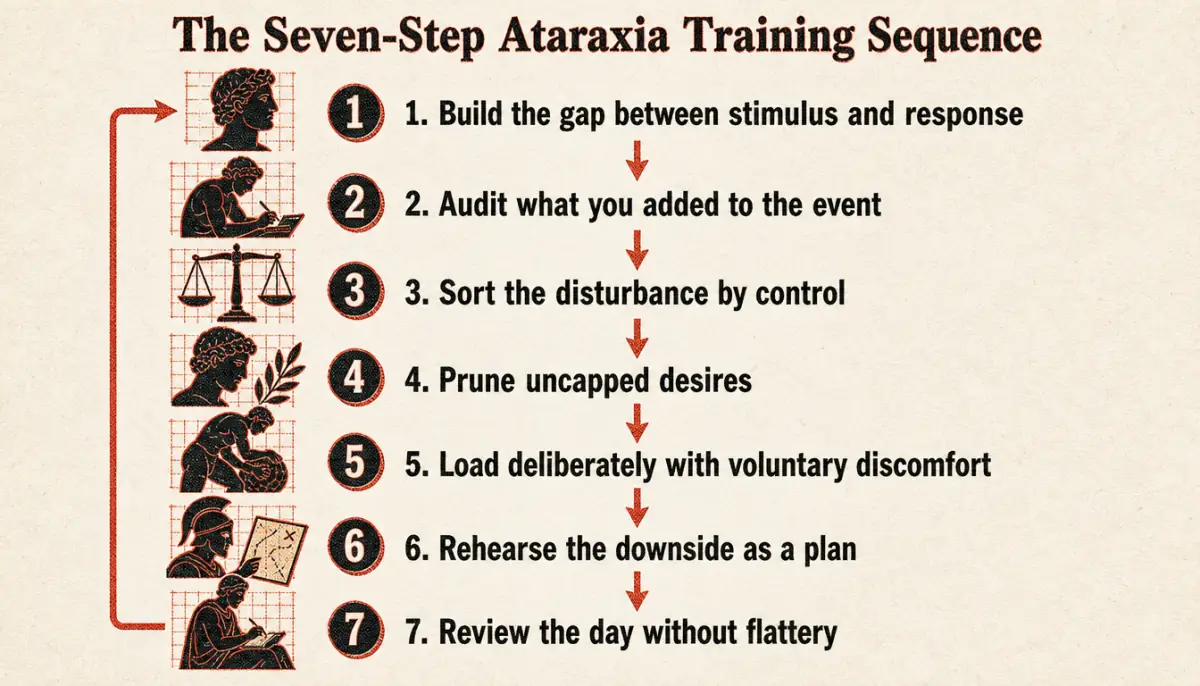
1. Build the Gap
Between stimulus and response there is an interval. In most men, untrained, it is close to zero. The first work is expanding it.
The mechanism is simple and unpleasant: when something provokes you, do nothing for a count of three before acting. Not to suppress, but to observe. You are inserting a wedge into an automatic sequence. The first weeks you will notice the gap only after you have already reacted. That is normal and still counts, because retrospective noticing becomes real-time noticing with enough repetition.
2. Audit the Judgment
Once the gap exists, use it. The Stoic question is: what did I add to this event?
Separate the raw fact from the interpretation. “He did not reply to my message” is a fact. “He is dismissing me” is an addition. “My presentation was rejected” is a fact. “I am not good enough for this level” is an addition. Nearly all disturbance lives in the addition, and additions are optional.
Write them out for the first month. Two columns, fact and addition. The exercise is tedious and the tedium is why most men skip it, which is also why most men remain reactive at forty.
3. Sort by Control
Take the disturbance and ask what portion of it is up to you. Almost always the answer splits into a small controllable piece and a large uncontrollable one.
Act on the controllable piece immediately, even if the action is small. Action on the controllable is what prevents this practice from becoming passive resignation. Then release the rest, not by pretending it does not matter, but by acknowledging that your concern produces no effect on it.
4. Prune the Desire Set
This is the Epicurean contribution, and men in this demographic tend to need it most. Examine what you are chasing and ask whether it has a ceiling.
Desires with ceilings can be satisfied: a specific income that covers a specific life, a body capable of specific work, a small number of close relationships. Desires without ceilings cannot: being seen as impressive, having more than the men around you, being universally respected. Every uncapped desire you carry is a permanent source of disturbance you have chosen to install.
You do not have to abandon ambition. You have to define its terms. “I want to build a business that supports my family and lets me work on hard problems” is a target. “I want to be successful” is a treadmill.
5. Load Deliberately
The Stoics practiced voluntary hardship: cold, hunger, plain clothing, sleeping rough. The point was never asceticism for its own sake. It was calibration. A man who has voluntarily gone without comfort knows experimentally that discomfort is survivable, and that knowledge removes the fear that generates most anticipatory disturbance.
Practical versions: train in bad weather, take cold exposure, fast periodically, spend a week without the specific comfort you rely on most. Then observe that you were fine. The observation is the whole payload.
6. Rehearse the Downside
Premeditatio malorum, the premeditation of evils, means spending a few minutes calmly considering what could go wrong and how you would handle it. Done poorly this is anxiety. Done correctly the emphasis falls entirely on the response, not the event.
The distinction: anxiety asks “what if this happens?” and stops there, looping. Premeditation asks “if this happens, what do I do first?” and answers. One generates disturbance, the other discharges it by converting an unbounded fear into a bounded plan.
7. Review Under Honest Conditions
End the day by reviewing where you were disturbed and what you added. Seneca described exactly this practice, questioning himself each night without flattery and without excessive harshness.
Honesty is the constraint that makes the review useful. A review that concludes you handled everything well is either accurate or worthless, and it is usually worthless. Look for the moment you got sharp with someone, the email you reread four times, the comment that stayed with you longer than it deserved. Those are your training targets for tomorrow.
Ataraxia, Masculinity, and Presence
There is a practical reason this concept belongs in a discussion of masculine development beyond its philosophical pedigree.
A man’s presence in a room is largely a function of how much of him is available. A man managing internal turbulence has most of his processing capacity committed to himself: monitoring how he is being perceived, rehearsing what to say, defending a position he has taken. Whatever attention remains for other people is thin. People feel this even when they cannot name it.
The steady man has capacity to spare. He listens without preparing his response. He can hold silence. He can receive a challenge without needing to neutralize it immediately. That capacity reads as authority, and no amount of posture or vocal training substitutes for it, because it is not a technique. It is a byproduct of having nothing urgent happening inside.
The same applies to the men who depend on you. A father whose internal weather governs the household has handed his family an unstable environment regardless of his intentions. Steadiness is infrastructure that other people build on.
The matrix below distinguishes ataraxia from the states it is most often confused with, using two axes that actually separate them.
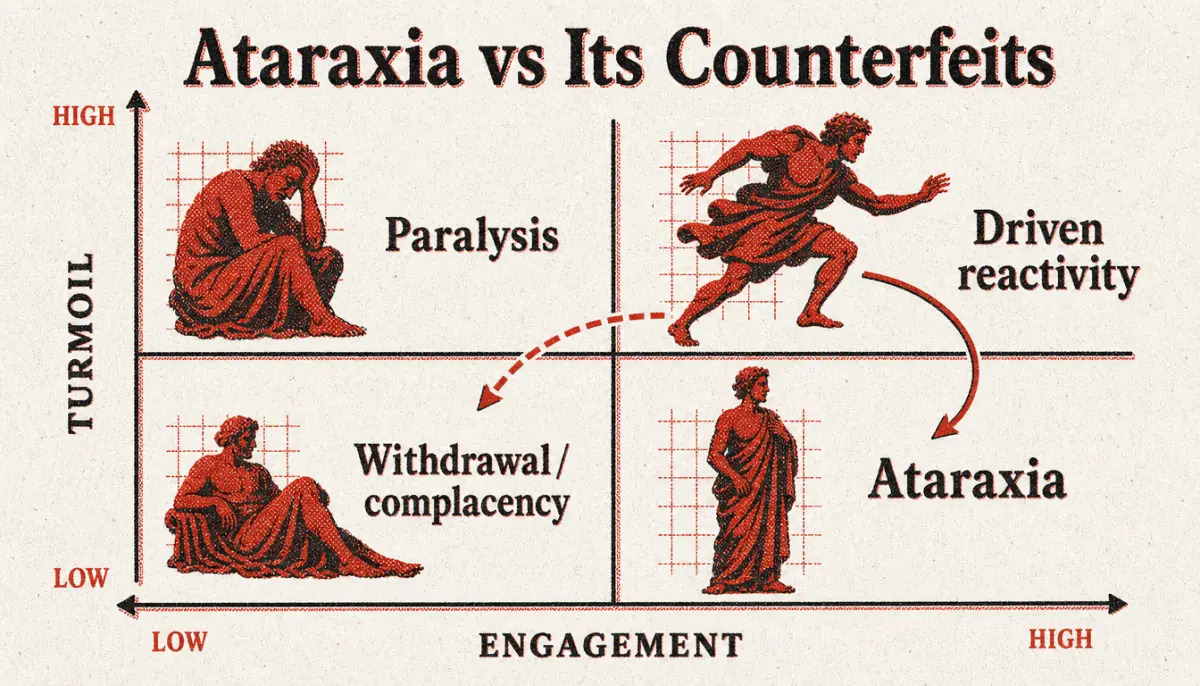
The two axes are internal turmoil and engagement with the world. Low turmoil plus high engagement is ataraxia. Low turmoil plus low engagement is withdrawal, which is what critics accuse the Stoics of and what some men use the philosophy to justify. High turmoil plus high engagement is the default state of the ambitious man, effective in bursts and expensive over decades. High turmoil plus low engagement is paralysis.
Most men who start this work are in the high turmoil, high engagement quadrant. The failure mode is drifting sideways into withdrawal, calling the resulting quiet ataraxia, and quietly abandoning their obligations. Guard against that. The test is simple: has your output dropped? If your standards have relaxed along with your anxiety, you found complacency, not stillness.
The Long Game: Ataraxia and What You Leave Behind
The Greeks did not present ataraxia as a productivity tool, and neither should you. But the connection to legacy is real.
Anything that outlasts you requires decades of consistent effort, and consistency is impossible for a man whose effort is governed by his emotional state. The disturbed man works brilliantly when motivated and disappears when he is not. He starts three ventures and finishes none. He is a good father on good weeks. Over thirty years, that variance compounds into very little.
The steady man’s daily output may be less dramatic. Its integral is enormous, because it does not stop. Marcus Aurelius wrote his private notes during military campaigns, which is to say he maintained his practice under conditions that would have given anyone a reasonable excuse to stop.
Ataraxia also changes what you build toward. A man driven by uncapped desires builds things designed to be seen. Remove the compulsion and what remains is what you actually care about, which is usually smaller, more specific, and more durable. The work gets better when it stops having to perform.
Summary
The essentials, compressed:
- Ataraxia is freedom from mental disturbance, from the Greek for “not stirred up.” It means the sediment has settled, not that the glass is empty.
- Three rival Hellenistic schools named it the goal. Stoics reached it by correcting judgment, Epicureans by pruning desire, Skeptics by suspending certainty. The agreement across hostile camps is strong evidence the target is real.
- It is trained, not felt. Treat it as a skill with load, reps, and progression, and the excuse of temperament disappears.
- The practice sequence runs: build the gap, audit the judgment, sort by control, prune uncapped desires, load deliberately, rehearse the downside, review honestly. Start at the bottom of the load scale.
- Distinguish it from suppression and complacency. Suppression delays the disturbance; complacency removes the standard. Ataraxia keeps the standard and dissolves the turmoil.
- It compounds. Steadiness is the precondition for consistency, and consistency is the only mechanism by which anything lasting gets built.
If you want to go further, the natural next subjects are the Stoic dichotomy of control as a standalone discipline, premeditatio malorum as a structured evening practice, and the Stoic theory of the passions, which explains the mechanism by which judgments become emotions. Each deepens the same foundation. None of them work by reading alone.