
The Man Who Trained Composure Under Pressure: An Analytical Breakdown
Most men chase calm before they act. He inverted the order: execute the correct conduct while feeling terrible, and let the calm arrive later as a byproduct. This analytical breakdown examines three behaviors that built his composure under pressure, the Stoic architecture underneath them, what the…
Contents
The Finding Worth Your Attention

A man who cannot stay level when the stakes rise will never be trusted with anything that matters. The pattern examined here belongs to a man who treated composure under pressure as a trainable skill rather than a personality trait, and built a deliberate system around it. The core discovery: he did not train himself to feel calm. He trained himself to act correctly while feeling terrible, and the calm arrived later as a byproduct.
That distinction collapses most of the advice circulating in men’s self-development. Breathing techniques, cold exposure, visualization, all of it assumes the goal is regulating the internal state first and performing second. He inverted the order. The analysis below breaks down what he actually did, why it worked, and what transfers to men who are not running his particular gauntlet.
Who We Are Examining and Why
The subject is a composite drawn from a recognizable archetype: the operator who performs consistently in conditions that degrade everyone around him. You have met versions of him. The surgeon whose hands do not change speed when the patient crashes. The negotiator whose voice stays at the same volume when the other side walks out. The founder who reads a bad quarter aloud to his team without flinching.
What unites them is not temperament. Many of them describe themselves as anxious, reactive, or prone to anger in ordinary life. Their composure is situational and constructed. They built it the way a man builds a deadlift: through progressive loading, technical correction, and tolerance for the discomfort of the working set.
The Stoics named this distinction long before modern psychology got to it. Epictetus separated what is up to us from what is not, and located all training in the first category. Marcus Aurelius wrote his journals at night not to feel better but to rehearse the next day’s conduct. Seneca advised practicing poverty on scheduled days so that real poverty would find him unimpressed. All three treated composure as a rehearsed behavior, not a mood to be summoned.
The man under analysis followed that lineage, whether or not he named it. His method has three observable components, examined in the sections that follow.
Three Behaviors That Separate Him

Watching him operate, three decisions recur. None of them are dramatic. All of them are counterintuitive enough that most men do the opposite by default.
He Deliberately Sought Out Losing Conditions
Most men build confidence by accumulating wins in environments where they hold an advantage. He did the reverse. He routinely placed himself in rooms where he was the least experienced person, in conversations where he lacked the vocabulary, and in physical settings where he was visibly outmatched.
The specific practice: he kept what he called a discomfort ledger. Each week he committed to one situation with a meaningful chance of public failure. Presenting an unfinished idea to people qualified to dismantle it. Sparring with someone better. Making a cold call where the likely answer was no and the rejection would be heard by colleagues.
What makes this notable is not the exposure itself. Exposure therapy is well understood. What makes it notable is that he tracked conduct, not outcome. His ledger did not record whether the pitch landed. It recorded whether his voice rose, whether he interrupted, whether he apologized reflexively, whether he broke eye contact when challenged. He scored the behavior and ignored the result entirely.
Over eighteen months, the pattern in his notes shifted. Early entries were dense with self-criticism about outcomes. Later entries read like a technician’s log: posture held, pace steady, one unnecessary qualifier used. He had converted a vague aspiration into a measurable practice.
He Separated the Signal from the Story Within Seconds
Under pressure, the mind produces two things simultaneously: information about the situation, and a narrative about what the situation means about you. Most men process them as a single stream. He trained to split them.
His method was blunt and verbal. When something went wrong, he would state the facts aloud or in writing, stripped of adjectives, before permitting himself any interpretation. The client ended the call at four minutes. Not: the client humiliated me. The numbers came in below projection. Not: I am failing and everyone can see it.
This sounds like standard cognitive reframing, and mechanically it overlaps. The difference is timing and repetition. He did not save it for reflection at the end of the day. He ran it in the moment, mid-conversation, as a spoken or subvocal discipline. He practiced it on trivial provocations so the habit would be available during serious ones. A delayed train. A rude email. A missed rep.
Epictetus described the same move: men are disturbed not by things but by their opinions about things. The insight is ancient and widely quoted. What separates the man under analysis is that he treated it as a motor skill requiring thousands of repetitions on low-stakes material, rather than a piece of wisdom to be recalled during a crisis.
He Made Slowness a Visible Signature
The third behavior is the most socially consequential. Under pressure, he slowed down in ways other people could see. He paused before answering. He asked a clarifying question instead of producing an immediate response. He set a pen down deliberately rather than gripping it.
He was explicit about the reasoning. Speed under pressure is a tell. It signals that the situation is driving the man rather than the man driving the situation. Deliberate slowness communicates the reverse, and it does so to two audiences at once: the people in the room, and the man himself.
The internal effect matters more than the external one. Physical deliberation feeds back into the nervous system. A man who forces his hands to move slowly while his heart rate is elevated is issuing a contradicting signal to his own arousal system. Over repetitions, the body learns that elevated heart rate does not require frantic action. The link between sensation and behavior weakens.
He described the rule as three seconds. Before any consequential reply, three seconds of nothing. No filler sounds, no shifting, no throat clearing. Most men find three seconds of silence unbearable at first. That discomfort is the training load.
What Actually Drives the System

The three behaviors are visible. The architecture underneath them is what makes them durable, and it diverges sharply from the standard self-improvement model.
The conventional approach treats pressure as a problem of state management. Get calm, then perform. Meditate, breathe, regulate, then act. This works in controlled settings and collapses in live ones, because the moment you need it most is the moment you have the least capacity to execute a regulation protocol. A man being cross-examined cannot run a ten-minute breathing sequence.
His model treats pressure as a problem of behavioral commitment. Define the conduct in advance. Execute it regardless of state. Let the state follow or not follow, but do not make it a precondition.
The diagram below contrasts the two models side by side.
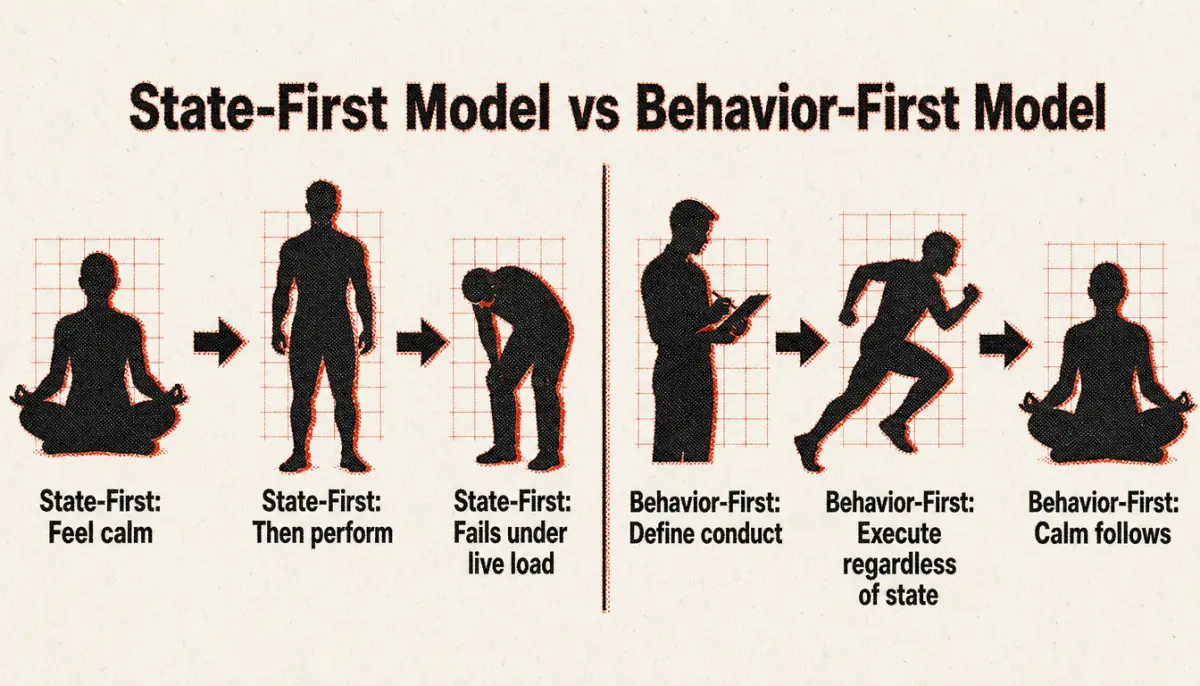
The practical consequence is significant. Under the state-first model, a man has failed the moment he feels anxious. Under the behavior-first model, anxiety is expected and irrelevant to the scorecard. He can be shaking and still win the rep, because the rep was defined as “did not raise voice, did not interrupt, held eye contact,” all of which are executable while shaking.
This maps directly onto the Stoic dichotomy of control. The feeling is not fully up to you. The conduct is. Training the conduct is training the only thing available.
The Standard Approach Versus His Approach
Placed side by side, the two systems differ on nearly every operational question.
| Dimension | Conventional Approach | His Approach |
|---|---|---|
| Primary target | Internal emotional state | Observable conduct |
| Success criterion | Feeling calm | Executing defined behavior |
| Timing of practice | Before and after high-stakes events | Continuously, on low-stakes material |
| Response to anxiety | Suppress or regulate it | Note it, proceed anyway |
| Feedback loop | Outcome-based (did it go well) | Process-based (did I hold form) |
| Failure definition | Losing composure or losing the result | Breaking the pre-committed conduct rule |
| Transferability | Situation-specific | Generalizes across domains |
The last row deserves attention. Men who train state regulation for public speaking often find it does nothing for confrontation with a superior, because the specific triggers differ. Men who train conduct commitments find the skill travels, because the commitment itself is content-neutral. Holding eye contact and pausing three seconds works in a boardroom, a negotiation, an argument with a partner, and a conversation about a medical diagnosis.
Why the Discomfort Ledger Outperforms Motivation
Motivation is a state. States fluctuate and cannot be scheduled. The ledger worked because it replaced a fluctuating input with a fixed one: a written commitment, made in advance, evaluated on behavior.
There is a secondary mechanism. Writing the entry before the event forces specificity. “Handle the meeting better” is not scoreable. “Do not fill silence, do not soften the number with a qualifier, do not apologize for asking” is scoreable, and the act of writing it clarifies what composure would actually look like in that room. Most men have never defined it, which is why they cannot execute it.
The Role of Consequence
He avoided simulation where real exposure was available. Practicing a difficult conversation in the mirror produces limited transfer, because the nervous system knows nothing is at stake. His preference was always for the live version with small real stakes over the rehearsed version with none.
The progression was graded, not reckless. He did not begin by confronting his employer. He began by sending food back at a restaurant, asking a stranger for directions, disagreeing aloud in a meeting where the topic did not matter. Small consequence, real consequence. The load increased as the form held.
Results and the Wider Ripple

Three categories of outcome are observable, and only one of them is the obvious one.
The first is performance. His behavior under pressure became predictable, which made him the person others called during crises. That is a compounding advantage. Every crisis he handled generated the reputation that produced the next invitation, and each invitation was another repetition.
The second is social. Composure functions as a signal, and people read it fast. A man who pauses before answering is read as considered. A man who does not flinch when contradicted is read as secure. He did not set out to manufacture presence, but the behavior produced it. Those around him began to mirror his tempo in meetings, which changed the character of the rooms he entered.
The third is internal, and it is the one he considered most valuable. The gap between how he behaved when observed and how he behaved alone narrowed. He stopped performing steadiness and started possessing it. That integration is the Stoic target: not a mask of virtue but the thing itself, where the public man and the private man converge.
The ripple extends beyond the individual. Composure is contagious in a group, and so is its absence. One man who does not escalate changes the ceiling of an argument. One man who slows down gives everyone else permission to think. In teams, families, and institutions, the presence of a single reliably level person alters what is possible in the room.
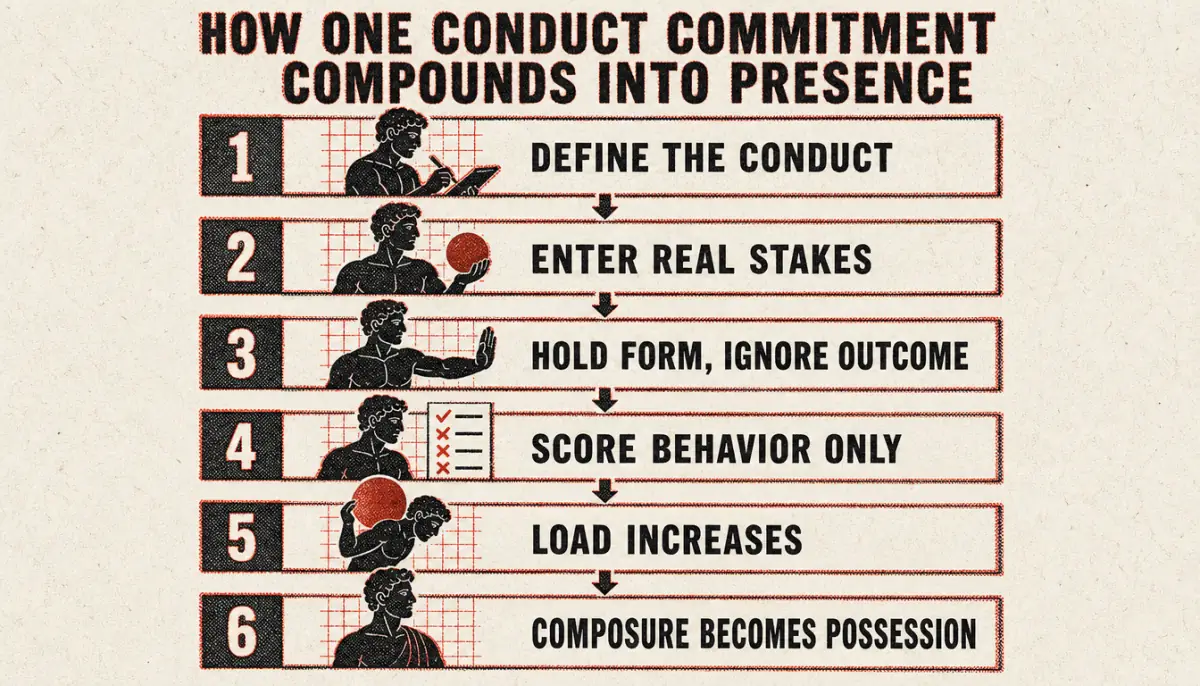
The process below shows how a single conduct commitment compounds into presence over time.
What It Cost Him
An honest analysis includes the debits. Three are worth naming.
He was sometimes read as cold. Deliberate slowness and controlled affect can register as distance, particularly to people who read warmth through responsiveness. He had to learn to signal engagement through other channels, mostly through the quality of his questions.
He underinvested in spontaneity. A man who pre-commits conduct in high-stakes situations can carry that rigidity into situations that call for looseness. He had to explicitly designate contexts where no rules applied.
He mistook suppression for composure in the early phase. For roughly a year, he was not regulating his responses so much as burying them, and it surfaced as irritability in unrelated settings. The correction was the signal-versus-story practice, which gave the internal material somewhere to go rather than nowhere.
What This Means for You
The transferable elements do not require his circumstances. They require a decision about what you are willing to measure.
- Define composure as a behavior before you attempt it. Write down, in advance and in specific physical terms, what holding form looks like in the next situation you are dreading. Voice at the same volume. No apology before the request. Eyes on the other person. If you cannot name it, you cannot execute it.
- Score conduct, never outcome. Keep a weekly record of whether you held your defined behavior, with the result of the encounter left out entirely. A rep you lost while holding form counts as a win. This is the single most important reversal in the system.
- Practice the split on trivial material. Every day, take one minor irritation and separate the fact from the story about you. The train is delayed. Not: the world is against me. Build the motor pattern where it costs nothing so it is available where it costs everything.
- Install the three-second pause this week. Before any consequential reply, three seconds of silence with no filler. It is the cheapest intervention available and it produces immediate feedback, both in how others respond and in how it feels to sit in the gap.
- Seek graded real exposure over rehearsal. One situation per week with genuine, survivable stakes. Start small enough that failure is trivial and real enough that your body registers it. Increase the load only when form holds at the current weight.
- Audit for suppression. If your control in high-stakes settings is producing irritability in low-stakes ones, you are burying rather than processing. Add the written fact-versus-story practice until the leakage stops.
The matrix below positions these practices by the effort they require against the leverage they produce, which should inform your sequencing.
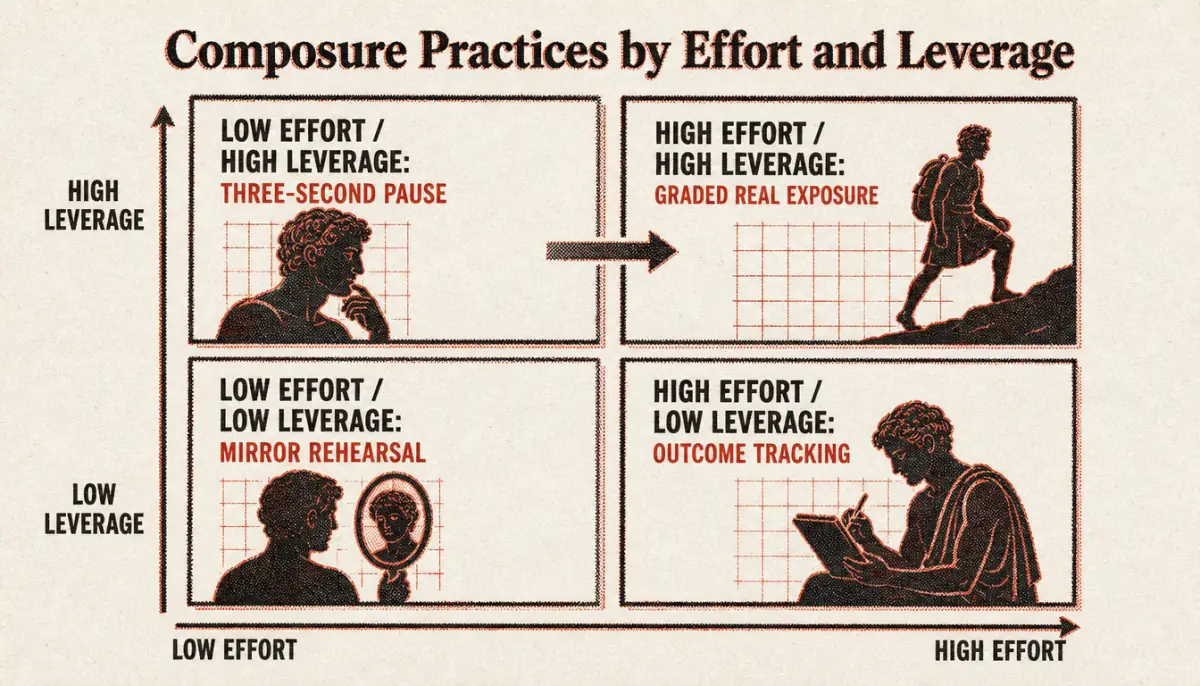
Begin in the high-leverage, low-effort quadrant. The three-second pause and the daily split cost almost nothing and change the texture of a week. The ledger and graded exposure demand more and should follow once the cheap practices are automatic.
Closing the Analysis
The central finding stands: he did not become calm and then perform well. He performed correctly while feeling awful, thousands of times, until the feeling stopped arriving with the same force. Composure was the residue of the practice, not its prerequisite.
This reverses the assumption underneath most of what men consume on the subject. You are not waiting for a state to arrive. You are executing a commitment while the state does whatever it does. The work is available today, in a conversation you are avoiding, in a three-second silence you are afraid to let stand.
What to watch in your own case over the coming months: the gap between your behavior when observed and your behavior alone. That gap is the real measure. When it narrows, the composure has moved from performance to possession, and you will notice it not in dramatic moments but in ordinary ones, where something that used to move you simply does not.