
How to Handle Disrespect Like a Stoic Instead of Reacting
Disrespect hits harder than it should because it attacks status, and status is wired into how men calculate their worth. This is a six-step Stoic protocol for handling insults, jabs, and provocations without losing your composure or your standing: interrupt the body, strip the verdict from the…

Contents
Goal: By the end of this article, you will have a repeatable internal protocol for handling disrespect, from a cutting comment in a meeting to a stranger testing you in public, without losing your composure or your standing.
Time required: About 15 minutes to read. Roughly 30 days to install.
Difficulty: Intermediate. The concepts are simple. The execution under pressure is not.
Why Disrespect Hits Harder Than It Should

A man can absorb physical discomfort, financial pressure, and long stretches of boredom. Then a colleague talks over him in a meeting, and his heart rate spikes for two hours. The disproportion is the interesting part.
Disrespect lands hard because it attacks status, and status is wired into how men calculate safety, opportunity, and worth. When someone treats you as beneath consideration, some older part of your nervous system reads it as a threat to your place in the group. That system does not distinguish between a tribal challenge and a passive-aggressive email.
The Stoics understood the mechanism without the neuroscience. Epictetus taught that we are disturbed not by events but by our judgments about events. The insult itself is sound waves or pixels. The wound comes from the internal ruling you issue: this diminishes me, and I must correct it now. That ruling is where your leverage lives, and it is the only part of the exchange you fully own.
Reaction feels like strength. It is usually the opposite. When you snap back, you hand the other person proof that they can move you with a sentence. A man who can be provoked can be steered. Every time you react, you teach the room how cheaply your composure can be bought.
What follows is not advice to swallow abuse or perform serenity. Stoicism is not passivity. It is the discipline of choosing your response instead of having it extracted from you. Sometimes the correct response is a hard boundary, a confrontation, or walking away permanently. The difference is that you select it rather than the insult selecting it for you.
What You Need Before You Start
This is a behavioral protocol, not a mindset poster. It requires a small amount of setup.
What you need:
- A notebook or notes app you will actually open, used for a short nightly review
- Two or three real incidents from the past month where you reacted poorly, written down with specifics
- One physical practice that already teaches you discomfort tolerance (training, cold exposure, fasting, long walks without input)
- A short list of your own actual values, three to five, written in plain language
Prerequisites:
- Basic willingness to be wrong about yourself. Most reactive patterns are protecting a soft spot you have not named yet.
- Enough self-honesty to distinguish between being disrespected and being corrected. These feel identical from the inside and are entirely different.
- A tolerance for delayed results. You will get this wrong in the first few live attempts, and that is part of the process, not evidence against it.
- No requirement for prior reading in philosophy. The relevant ideas are stated plainly here.
One warning before the steps. If you are currently in a situation involving ongoing intimidation, threats, or physical danger, composure practice is not the right tool. Remove yourself and get appropriate help. The protocol below assumes ordinary social friction, not genuine harm.
The Six-Step Protocol for Handling Disrespect

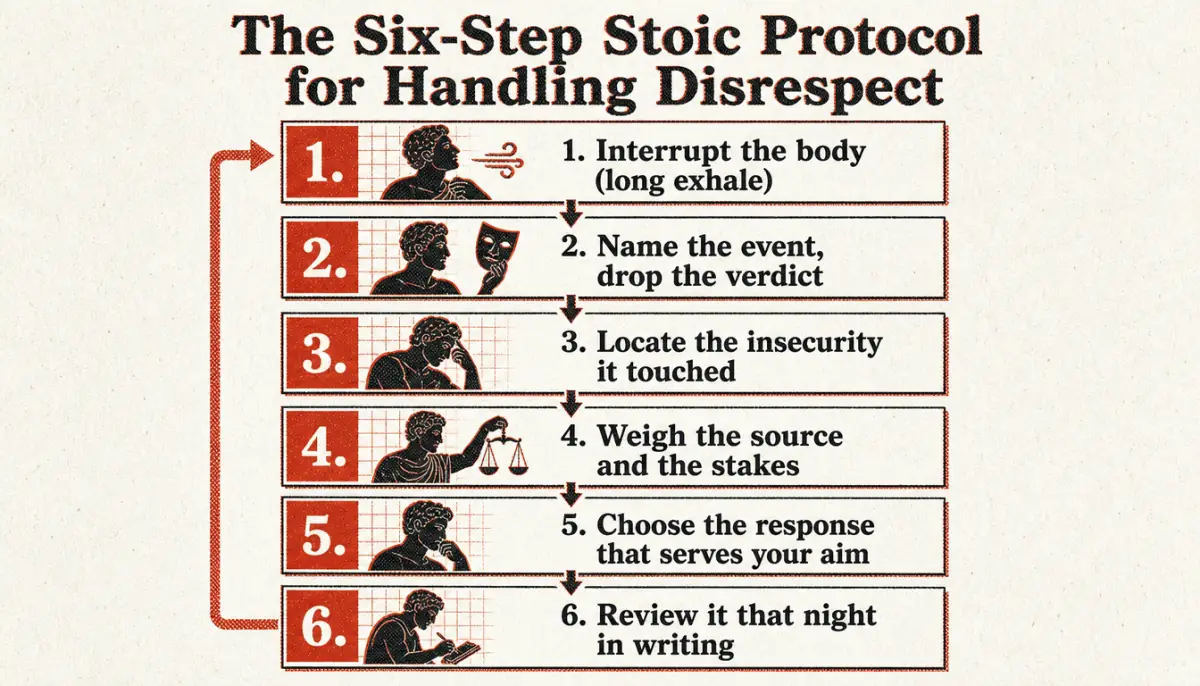
Each step is one action. Practice them in order at first. Over time they compress into something closer to a single reflex that takes about four seconds.
The diagram below shows the full sequence for how to handle disrespect, from the moment the comment lands to the response you choose.
Step 1: Interrupt the Body Before You Interrupt the Person
Before any judgment, your body commits. Jaw tightens, shoulders rise, breath goes shallow and high in the chest, temperature climbs in the face and neck. This happens in under a second, well ahead of conscious thought. If you try to think your way out of an insult while your physiology is already in fight posture, you will lose. The body sets the terms.
So the first move is physical and it has nothing to do with the other person. Exhale. Longer than you want to. Then let the shoulders drop and unclench the jaw. That is it. One slow exhale buys you the pause in which everything else becomes possible.
Practice this cold, away from conflict. Three times a day, deliberately tense your jaw and shoulders, then release them on a long exhale. You are building a motor pattern you can find under stress. A skill you have never rehearsed calmly will not appear in the middle of a confrontation.
→ If you notice one full exhale before your first word, this step is working. You do not need to feel calm. You only need the breath.
Step 2: Name the Comment Without the Verdict
Now separate the event from your ruling about it. Epictetus called this working on impressions. The event is what a camera would record. The verdict is the story you attach.
Practically, restate what happened in flat, factual language, silently, to yourself:
- Verdict: “He humiliated me in front of the whole team.” → Event: “He interrupted me twice and used the word obviously.”
- Verdict: “She thinks I’m a joke.” → Event: “She did not respond to my message for four days.”
- Verdict: “That guy was trying to test me.” → Event: “A stranger made a comment about my jacket and laughed.”
Notice what drops away. The event contains no assessment of your worth. Your worth was never on the table. You put it there.
This is not denial. The interruption happened, and it may well have been a deliberate move for position. Name that too, but name it as a fact about his behavior rather than a fact about your value. “He is competing for status in meetings” is information you can use. “He humiliated me” is a wound you now have to defend.
→ If you can state the incident in one sentence with no adjectives about yourself, you have completed this step.
Step 3: Locate the Source of the Sting
Insults do not land at random. They land where you are already unsure. A comment about your income only stings if you have private doubts about your earning. A jab about your competence only lands if some part of you suspects it might be true.
Marcus Aurelius wrote to himself constantly about this, checking his own reactions for the vanity underneath. When you feel disproportionate heat, ask one question: what belief of mine did that comment touch?
The answers tend to be uncomfortable and useful:
- “I need this person’s approval more than I admit.”
- “I am not actually confident in my work on this project.”
- “I have been avoiding a conversation I should have had weeks ago.”
- “I want to be seen as the smartest person in the room, and I resent evidence against it.”
Every insult that lands hands you a free diagnostic. The heat marks the exact location of the work. Men who chase composure without doing this step end up with a suppressed version of the same reactivity, which leaks out later at the wrong people.
→ If you can name the specific insecurity the comment touched, you have the real information from the exchange. If nothing comes up and the sting fades quickly, that is also valid. Not every comment is about you.
Step 4: Judge the Source and the Stakes
Not every comment deserves the same weight. The Stoics were selective about whose opinion they weighted, and so should you be. Marcus reminded himself to consider what kind of person the critic was, what they valued, and how they lived, before granting their judgment any authority.
Run a fast triage on two variables: does this person’s opinion carry legitimate weight in your life, and does this situation carry real consequences?
| Source | Stakes | Correct response |
|---|---|---|
| Someone you respect, whose judgment you have reason to trust | High | Treat it as feedback. Ask a clarifying question. Consider that they may be right. |
| Someone you respect | Low | Acknowledge briefly, take the useful part, move on. |
| A peer or rival competing for position | High | Set a clear, unemotional boundary in the moment. Address it directly afterward. |
| A peer or rival | Low | Minimal response. Silence or a single dry line. Do not escalate over nothing. |
| A stranger, or someone whose life you would not trade for | Any | Disengage. Their assessment of you carries no information. |
Most disrespect that occupies a man’s evening comes from the bottom row. He replays a comment from someone whose opinion he would never seek on any decision that mattered. Ask yourself plainly: would I take advice from this person about my career, my training, or my marriage? If not, why am I taking their assessment of my worth?
→ If you can place the incident in one row of that table within a few seconds, this step is working.
Step 5: Choose the Response That Serves Your Aim
Now you act, and you act from your objective rather than your irritation. The question is not “how do I get even?” but “what outcome do I want here, and what response moves toward it?”
You have four real options. Each is legitimate. The failure is using them unconsciously.
- Silence. Not the sulking kind. The kind that simply does not engage. Silence in response to a provocation communicates that the provocation did not reach anything. It is the strongest move against status-seeking jabs from people whose opinion you have already discounted.
- The flat acknowledgment. “Noted.” “That’s your read.” “Could be.” Delivered without heat, these end the exchange without conceding anything. They deny the other person the escalation they were angling for.
- The clean boundary. Specific behavior, specific requirement, no adjectives. “Don’t interrupt me while I’m presenting numbers.” “I’m not discussing my salary at dinner.” A boundary works when it describes a behavior rather than attacking a character. Say it once, evenly, then hold it with your actions.
- The direct confrontation. Reserved for patterns, not incidents, and best done privately and later. “This is the third meeting where you’ve cut me off. What’s going on?” Deliberate confrontation is a Stoic act when it serves justice. Reactive confrontation is only temper with better vocabulary.
The comparison below helps clarify the distinction between reacting and responding.
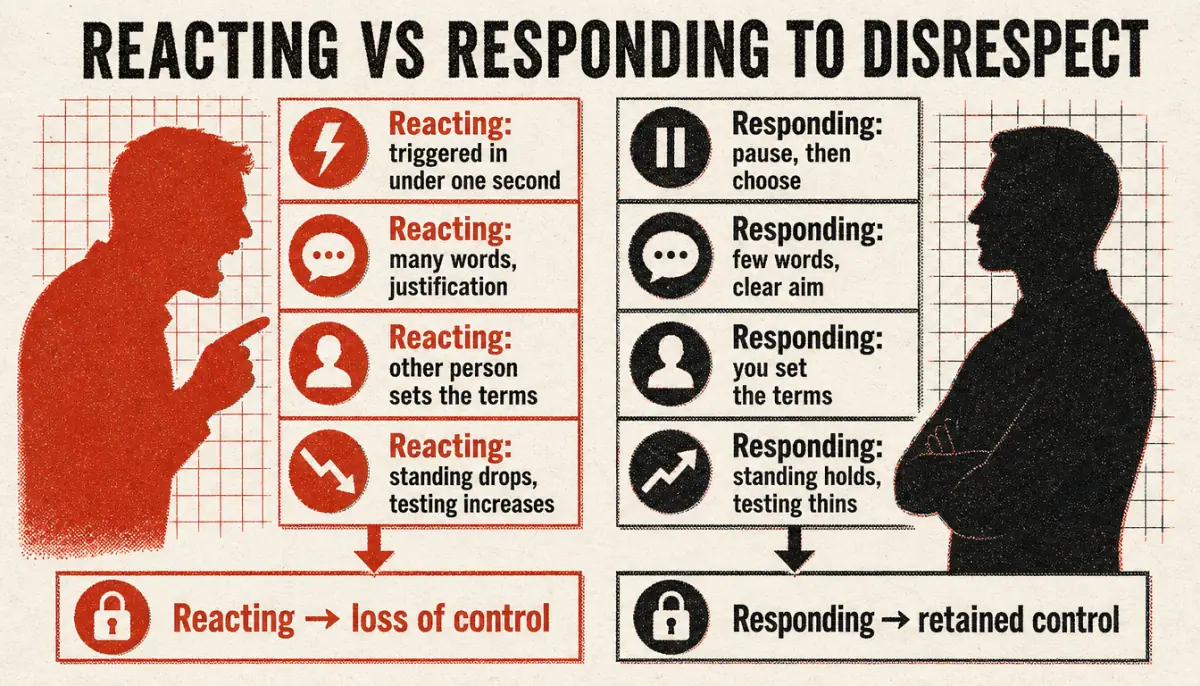
One rule cuts through most of the difficulty: if you would not choose this response tomorrow morning, do not choose it now. Delay costs almost nothing. Reaction costs standing.
→ If you can state your objective before you speak, even in a single silent phrase, you have completed this step.
Step 6: Run the Review That Night
The Stoics closed every day with an examination of their conduct. This is where the protocol becomes permanent rather than occasional.
Four lines in a notebook. No more than five minutes.
- What happened? Facts only, as in Step 2.
- What did I feel, and where did it hit? The insecurity from Step 3.
- What did I do? Honest. Including the tone, not just the words.
- What will I do next time? One specific alternative.
Do this for thirty days and patterns surface that you cannot see in the moment. Most men discover that their reactivity concentrates in two or three predictable triggers, often with the same handful of people, often when they are tired, hungry, or already behind on something that matters. That map is worth more than any amount of reading about equanimity.
→ If you have written entries on at least twenty of thirty days, the habit is forming. Perfect consistency is not the target. Continuity is.

What It Looks Like When It’s Working

After a few weeks of deliberate practice, the changes are noticeable but quieter than most men expect. There is no moment of arrival where insults stop registering.
Here is what you should see instead.
The gap widens. Where a comment used to trigger a response in under a second, there is now a pause. Short at first, half a second, then longer. That gap is the entire skill. Everything else is decoration on top of it.
The recovery accelerates. You will still get heated. The difference is duration. A comment that used to occupy three hours of mental rehearsal now occupies twenty minutes. Then five. The decay curve steepens, and that is the most reliable measurable sign of progress.
Your responses become shorter. Reactive men over-explain, over-justify, and over-qualify. Composed men use fewer words. When you stop needing the other person to agree with your assessment of yourself, sentences get much shorter.
People calibrate differently around you. This is the effect no one anticipates. When provocation stops producing a reaction, provocateurs lose interest. There is no return on the investment. Some of the people who tested you regularly will simply stop, without any conversation about it.
You confront more, not less. Counterintuitive but consistent. Reactive men avoid real confrontation because their emotions run the encounter and they know it. Once you trust your own composure, you become willing to raise difficult things directly, calmly, on your timing. Composure is what makes hard conversations survivable.
If you are experiencing the opposite, tightness in the chest, a sense of swallowing things, resentment building toward specific people, you are suppressing rather than processing. That is a different failure, and the next section covers it.
Common Failure Modes and How to Fix Them

Nearly every man attempting this protocol runs into at least two of the following. They are predictable, which means they are correctable.
| Symptom | Cause | Fix |
|---|---|---|
| You stay calm in the moment, then replay the exchange for hours | Suppression, not processing. Step 3 was skipped, so the insecurity was never named | Do the written review that night. Name the specific belief the comment touched. Replay stops when the underlying question is answered |
| Resentment accumulating toward one particular person | You are using silence where a boundary was required. Silence against a pattern reads as permission | Move to option 3. One clear, behavior-specific boundary, stated once, then enforced by your actions |
| Composure holds at work, collapses at home | Willpower depletion plus lower perceived stakes with people who will not leave | Practice the physical interrupt at home first, where the cost of failure is highest. Also address sleep and food, which drive most evening reactivity |
| You feel passive and slightly ashamed after staying calm | Confusing composure with submission. You chose silence but never chose an objective | Always complete Step 5 explicitly. If the correct response is confrontation, confront. Composure is how you do it, not whether |
| Everything feels like disrespect lately | A sensitivity spike, usually from exhaustion, insecurity in a specific domain, or an environment that genuinely does not respect you | Review thirty days of notes. If the trigger is spread across all people and contexts, the problem is your state. If concentrated in one environment, the problem is the environment |
| You perform calm, and people find it smug | Performed serenity reads as contempt. You are using composure as a superiority display | Drop the theatrics. No knowing pauses, no faint smile. Respond plainly and move on. Real composure is unremarkable to watch |
That last one deserves emphasis. Some men discover that visible unflappability is a way to win exchanges and start deploying it as a weapon. That is vanity wearing a philosopher’s costume. Seneca warned repeatedly about virtue practiced for display. If you are enjoying how composed you appear, you have swapped one form of status-seeking for another.
Advanced Application: Building a Reputation That Prevents the Problem

Once the six steps run reliably, the work shifts from handling individual incidents to shaping the conditions that produce them. Most disrespect is probing behavior, an inexpensive test of where you sit and how you respond. Change what the test returns and the testing thins out.
Make Your Standards Legible
Men who get tested constantly often have unclear edges. Their boundaries move depending on who is pushing and how tired they are. That inconsistency is an invitation, because inconsistent limits are worth probing.
Legible standards are stated once and then enforced without discussion. You do not take work calls after a certain hour. You do not discuss your family with colleagues. You leave when someone gets drunk and personal. State the rule plainly the first time it comes up, then let your behavior repeat it. Within a month, people stop testing that edge because the answer has become boring and predictable.
Separate Status From Respect
These get conflated constantly. Status is your position in a hierarchy, and it fluctuates with performance, politics, and luck. Respect, in the sense worth having, is what people extend to a man whose conduct is consistent. You control the second one almost entirely.
A man chasing status reacts to every slight because each one threatens the ranking. A man building respect can lose status contests without much disturbance, because his self-assessment rests on conduct rather than position. This is the practical meaning of the Stoic distinction between what is up to us and what is not. Your rank is partly external. Your conduct is fully yours.
Use Deliberate Discomfort as Training Ground
Composure is a general capacity. Training it anywhere strengthens it everywhere. Hard physical work, cold water, extended fasting, and difficult conversations all rehearse the same underlying skill: registering an unpleasant signal without letting it dictate behavior.
Seneca recommended periodic voluntary hardship so that hardship, when it arrived unchosen, would find him already familiar with it. Applied here, that means seeking situations where you feel the urge to react and do not act on it. The heavy set where you keep your breathing even. The cold shower where you stop bracing. The difficult email you answer in three sentences instead of thirty. These are all the same rep.
Choose Rooms Worth Standing In
Individual technique has limits. Some environments run on contempt, and no amount of composure makes them survivable long term. A workplace where undermining is the standard operating procedure, a friend group where cruelty passes for humor, a relationship where dismissal is the default tone. You can handle these with skill for a while. You should not plan to handle them for a decade.
Stoicism does not require endurance for its own sake. It requires you to act well in the circumstances you have, which includes changing circumstances you can change. The decision to leave, made calmly and on your own timing, is as much a Stoic act as the decision to stay and hold the line. What matters is that you choose it rather than being driven out by an accumulation of unprocessed slights.
Putting It Into Practice
The whole protocol compresses to this: interrupt the body, strip the verdict from the event, find what it touched, weigh the source, choose the response that serves your aim, and review it that night. Six moves, and the first one buys you all the others.
Start with a single step. Most men who try to install all six at once abandon the effort inside a week. Take Step 1 alone. For seven days, practice the exhale and the shoulder drop, three times a day when nothing is happening, and once in every exchange that irritates you. When it becomes automatic, add the nightly review. Build from there.
The next thing worth examining is the ground underneath this. Composure under disrespect works because your self-assessment rests on something the other person cannot reach. If yours currently rests on their approval, no technique will hold under real pressure. That means the deeper work is defining your own standards clearly enough that another man’s opinion becomes information rather than a verdict.