
How to Build a Personal Code of Conduct in One Page
Most men run on inherited behavioral defaults they've never examined. This guide walks through a seven-step process for building a personal code of conduct that fits on one page: inventory your failures, identify the repeating patterns, write non-negotiables that actually cost you something,…
Contents
What you’ll walk away with: a single-page personal code of conduct that names your non-negotiables, defines how you behave under pressure, and gives you a specific test for whether you kept your word today.
Time required: about 90 minutes of focused work, split across two sittings.
Difficulty: intermediate. The mechanics are simple. The honesty required is not.
Why One Page, and Why Most Men Never Write One

Most men operate on inherited defaults. You absorbed a set of behavioral rules from your father, your first boss, the locker room, and whatever media you consumed between fifteen and twenty-five. Those rules run in the background. You’ve never audited them, never written them down, and you only notice they exist when one of them fires at the wrong moment and you say something you regret.
A personal code of conduct pulls those defaults into the light. You examine them, keep what serves you, discard what doesn’t, and commit the remainder to a document you can read in ninety seconds. The Stoics understood this as the difference between being pushed by impulse and being governed by prohairesis, your faculty of considered choice. Epictetus taught students to rehearse their principles before the situation arrived, not to invent them mid-crisis.
The one-page constraint is doing real work here. Anything longer becomes a document you write once and never open. A fifteen-page manifesto is a procrastination artifact dressed as commitment. If your code cannot be read in the time it takes to tie your boots, it will not be read at all.
The second reason men skip this: writing a code creates a measurable standard, and a measurable standard creates the possibility of visible failure. Vagueness is comfortable. “I try to be a good man” can never be falsified. “I do not raise my voice at people who cannot raise theirs back” can be checked against yesterday. That discomfort is the point.
The difference between values, goals, and a code
These three get blended together constantly, and the confusion is why so many attempts collapse into a list of adjectives.
| Element | Answers | Example | Failure mode |
|---|---|---|---|
| Value | What matters to me? | Integrity | Abstract, unfalsifiable |
| Goal | What am I pursuing? | Run a sub-3 marathon | Ends on completion |
| Code | How do I behave, regardless of outcome? | I finish what I start, or I state out loud that I’m quitting and why | Requires daily enforcement |
A code sits between philosophy and habit. It is specific enough to enforce and stable enough to survive changing circumstances. Your goals will rotate every few years. Your code should barely move.
Prerequisites: What You Need Before You Start
What you need:
- A single sheet of paper and a pen for drafting. Not a laptop. The friction of handwriting slows you down enough to think.
- Ninety uninterrupted minutes, ideally split into two sessions with a night’s sleep between them.
- A plain text file or a printed card for the final version.
- A private space. This draft is not for anyone else’s eyes.
Prerequisites:
- Recent memory of a failure. You need at least three specific incidents from the past year where you acted against your own judgment. Not vague regrets. Specific events with dates, people, and consequences.
- Willingness to be unflattering. The first draft of a useful code reads like an indictment. If your draft makes you feel good about yourself, you wrote a brochure.
- Acceptance that this is version one. You will revise it. Perfectionism at this stage is avoidance.
One more thing to prepare: a decision about who sees it. Most men should keep the first version private for at least ninety days. A code shown to others too early becomes a performance, and you’ll unconsciously write lines that sound good rather than lines that bind you.
The Seven-Step Build Process

The process moves from raw evidence to a finished, testable document. The diagram below shows the full sequence from failure inventory to the daily review that keeps the code alive.
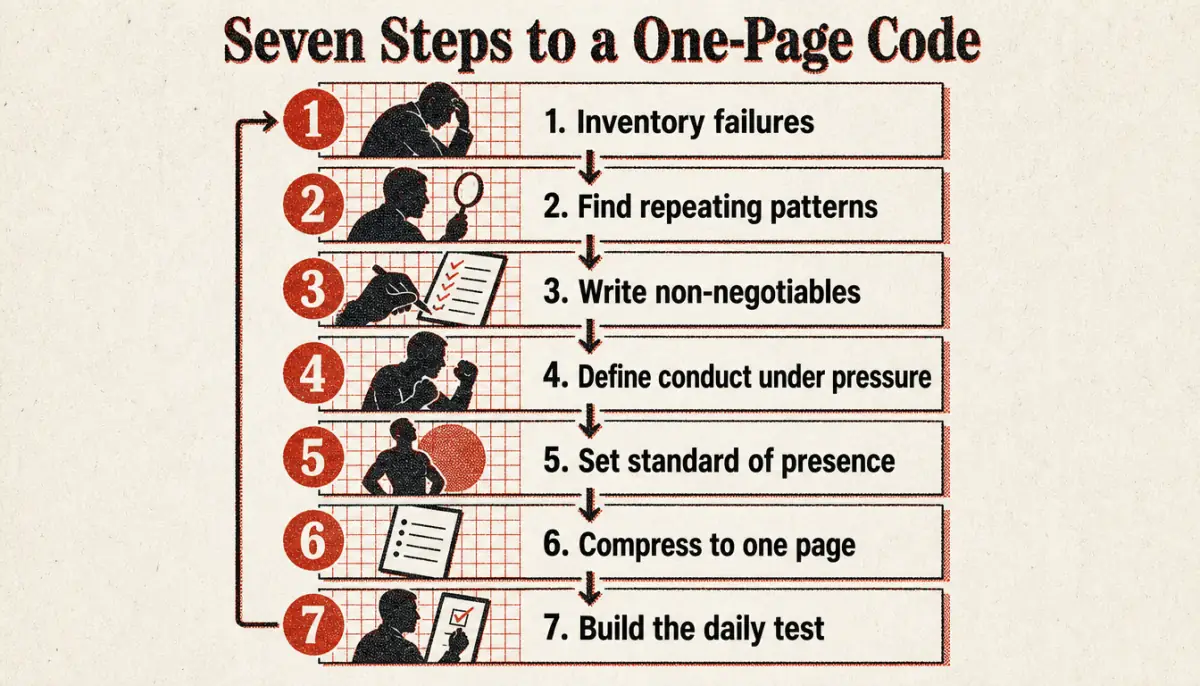
Step 1: Inventory your failures
Open your notebook. Write down every instance from the past twelve months where you behaved in a way you would not defend to someone you respect. Aim for fifteen entries. Ten is a working minimum.
Write each one as a factual sentence with no justification attached. “Told Marcus I’d review his proposal by Friday, sent it the following Wednesday without apologizing.” Not “I’ve been overwhelmed at work and communication has slipped.” The moment you attach a reason, you have started defending, and defense kills the diagnostic value of the exercise.
Cover all four domains deliberately, because men tend to over-audit one and ignore the rest:
- Physical discipline: training skipped, sleep sacrificed, substances used to manage mood
- Emotional regulation: raised voice, sulking, withdrawal used as punishment
- Social conduct: gossip, false agreement, flattery, silence when you should have spoken
- Commitments: deadlines missed, promises softened, plans abandoned without notice
→ You’re done when the list makes you want to stop writing. That resistance signals you’ve reached material worth building on.
Step 2: Find the repeating pattern
Read the list twice. Circle entries that share a mechanism, not a category. Two missed deadlines and one unreturned call might all trace back to the same root: you say yes to avoid an uncomfortable thirty-second conversation, then pay for it over weeks.
Most men find three to five recurring mechanisms. Common ones:
- Agreeing in the moment to avoid friction, then quietly defaulting
- Using busyness as a cover for avoiding a specific hard task
- Escalating volume or sarcasm when you feel your competence questioned
- Withdrawing from people when things go badly, exactly when contact matters most
- Chasing a new project as an escape from an unfinished one
Name each mechanism in one sentence, in your own words. These names are the raw material for your clauses. Marcus Aurelius wrote his Meditations as repeated corrections to the same handful of flaws, which is exactly what you’re doing, just compressed.
→ You’re done when you can state each pattern without referring back to the incident list.
Step 3: Write your non-negotiables (the hard floor)
Non-negotiables are the lines you do not cross regardless of cost, mood, or circumstance. These are not aspirations. They are the floor beneath which your behavior does not go.
Write three to five. Not more. A man with twelve non-negotiables has zero, because he cannot hold twelve absolutes in his head under pressure.
Each one must pass three tests:
- Behavioral, not emotional. “I do not lie about what I’ve done” works. “I feel honest” does not.
- Observable by a third party. Could someone watching your day determine whether you kept it?
- Costly at least once. If keeping it has never cost you anything, it is a description of your convenience, not a commitment.
Weak version: “I value honesty.”
Strong version: “I do not misrepresent my work, my effort, or my reasons, even when the accurate version makes me look worse.”
Weak version: “I take care of my health.”
Strong version: “I train four days a week. When travel or illness breaks the pattern, I resume within seventy-two hours without renegotiating the standard.”
→ You’re done when each non-negotiable names a specific behavior you could have violated yesterday.
Step 4: Define your conduct under pressure
Non-negotiables cover the floor. This section covers the situations where you actually break: conflict, criticism, fear, boredom, and temptation. Your code is worth nothing if it only holds on calm Tuesdays.
Return to your patterns from Step 2 and write a conduct clause for each one. The structure that works:
“When [specific trigger], I [specific action], because [principle].”
Examples with the structure filled in:
- “When someone challenges my competence in front of others, I ask a clarifying question before responding, because my reputation survives being wrong and does not survive being defensive.”
- “When I’m asked for a commitment on the spot, I say I’ll confirm within twenty-four hours, because a fast yes I break costs more than a slow yes I keep.”
- “When a project stops being interesting, I finish the current phase before deciding, because the version of me who wants to quit is not the version who chose the work.”
The “because” clause matters more than it looks. Under stress you will not recall the rule, but you may recall the reason. Epictetus called this having your principles ready to hand. A rule without its reason is a rule you’ll rationalize around within a month.
Write four to six of these. They are the working engine of the document.
→ You’re done when each of your top patterns from Step 2 has a matching conduct clause.
Step 5: Write your standard of presence
This section governs how you show up with other people: your word, your attention, your bearing. Men who build a code often skip this and end up with a private discipline document that makes them no better to be around. That’s a self-improvement project, not a code of conduct.
Cover three areas in one or two lines each:
- Your word: what a commitment from you means, and what you do when you can’t keep one. Example: “If I cannot meet a commitment, I say so before the deadline, not after, and I propose the replacement myself.”
- Your attention: how you treat someone’s time in conversation. Example: “When someone is speaking to me, my phone is out of my hands. I do not perform listening while waiting to talk.”
- Your bearing: how you carry status, in both directions. Example: “I speak the same way to the person who can do nothing for me as to the person who can do everything.”
This is where masculine presence stops being a vague aesthetic and becomes a set of enforceable behaviors. Presence is not volume or posture. It is the observable consistency between what you say and what you then do.
→ You’re done when a person who spent a week with you could verify each line.
Step 6: Compress to one page
Your draft is now too long. Good. Compression is where the code gets its teeth.
Move everything to a single page using this layout:
| Section | Lines | Function |
|---|---|---|
| Non-negotiables | 3-5 | The floor you never cross |
| Conduct under pressure | 4-6 | Behavior when triggered |
| Standard of presence | 3 | How you treat others |
| The daily test | 1 | Tonight’s review question |
Apply these cuts ruthlessly:
- Delete anything you already do reliably. If you’ve never missed a training session in three years, it doesn’t need a line. A code addresses the gap, not the strength.
- Delete anything that sounds like a quote. If the line would look good on a poster, it’s decoration. Replace it or cut it.
- Merge overlapping clauses. Three lines about honesty become one sharper line.
- Cut every adverb. “I always try to consistently” collapses into “I do.”
Target between twelve and sixteen total lines. If you’re over, you’re protecting something you don’t want to cut.
→ You’re done when the whole thing fits on one side of a page at readable size, with room to breathe.
Step 7: Build the daily test
A code with no review mechanism decays into a document about the man you once intended to be. The enforcement mechanism is one question, asked at the same time every day.
Seneca described reviewing his own day each evening, examining where he had done well and where he had fallen short, without either flattery or excessive self-attack. The practice is old and it works because it is short.
Write one question at the bottom of the page that targets your single most frequent pattern. Examples:
- “Where did I say yes today when I meant no?”
- “What did I avoid, and what did I do instead?”
- “Who did I treat as smaller than me?”
Answer it in writing, in one or two sentences, every night. Not a journal entry. A log line. Thirty seconds.
→ You’re done when your page has exactly one review question and you’ve answered it once.

Confirming Your Code Works

If you completed all seven steps correctly, you now have a single page with twelve to sixteen lines, organized into four sections, ending in one review question. The page contains no adjectives about your character and no quotations from anyone else.
Run these four checks before you consider it finished.
The stranger test
Hand your page to someone who doesn’t know you and ask what they could observe about you next week if you followed it exactly. If they can describe specific behaviors, the code is operational. If they say “seems like you value integrity,” you wrote values, not conduct. Return to Step 3.
The cost test
Go line by line and answer: when did keeping this last cost me something real? Money, status, comfort, or a relationship. Any line that has never cost you anything is describing what you’d do anyway. It’s filler. Either sharpen it until it bites or remove it.
The recall test
Put the page away for forty-eight hours. Then write down as many lines as you can remember. If you recall fewer than seven, the language is too abstract or the page is too long. Rewrite the forgotten lines in blunter words.
The pressure test
Take the three worst entries from your Step 1 failure inventory. For each one, find the line in your code that would have stopped it. If any of the three has no corresponding line, you built a code for a man with different problems than yours.
The comparison below shows the practical difference between a document that sits in a drawer and one that changes behavior.
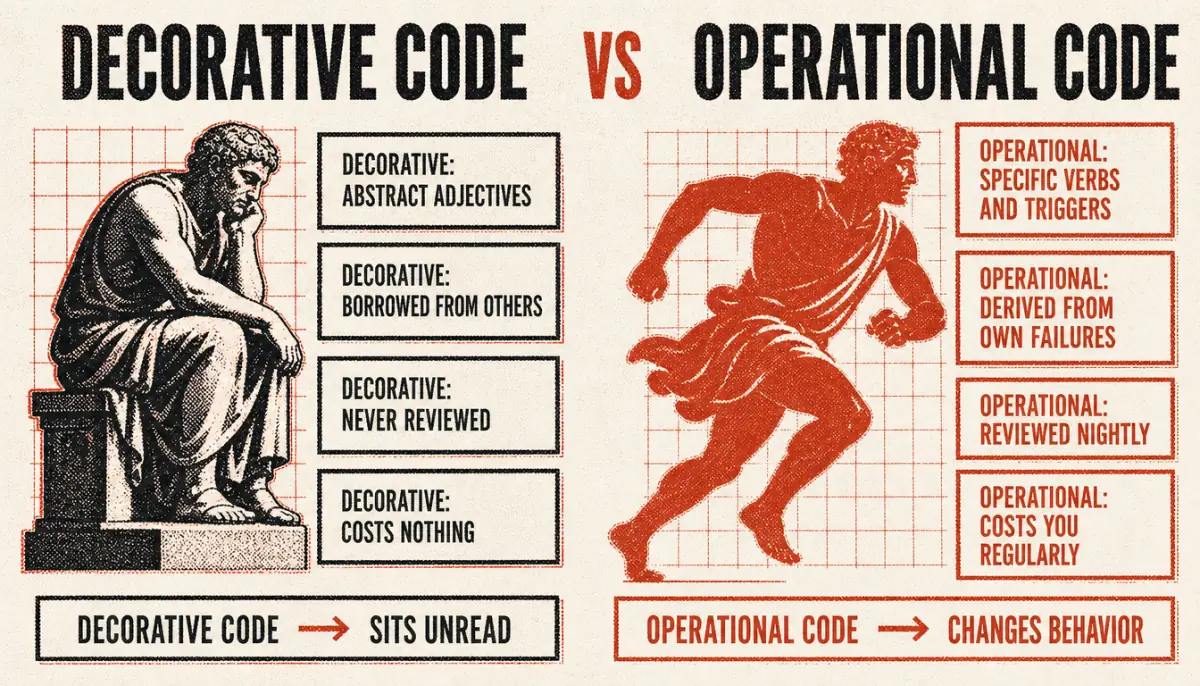
| Attribute | Decorative code | Operational code |
|---|---|---|
| Language | Adjectives, abstractions | Verbs, specific triggers |
| Length | Multiple pages or one vague list | 12-16 lines, one page |
| Origin | Borrowed from books or figures you admire | Derived from your own documented failures |
| Verification | None, or an annual reread | One daily question, answered in writing |
| Cost of compliance | Zero | Regular and specific |
| Revision | Never, or total rewrite when abandoned | Quarterly, with reasons logged |
Common Failure Modes and How to Fix Them

Codes fail in predictable ways. Most of them are visible within the first month.
| Symptom | Cause | Fix |
|---|---|---|
| You haven’t opened the page in two weeks | No trigger attaching review to an existing habit | Anchor the daily question to something you already do without fail, such as setting your alarm |
| Every nightly review says “good day, no issues” | Review question is too broad to catch anything | Replace it with a question targeting one named pattern from Step 2 |
| You break the same clause repeatedly and feel nothing | The clause was aspirational, not achievable at your current baseline | Lower the standard to something you can hold, then raise it after thirty consecutive days |
| Reading the code makes you feel like a fraud | You wrote the man you want to appear as, not the man you’re building | Cut every line you can’t currently defend, even if the page shrinks to six lines |
| The code makes you rigid and unpleasant to be around | Non-negotiables written as rules for others rather than yourself | Rewrite every clause so the subject is “I” and the obligation falls only on you |
| You keep rewriting instead of following it | Revision is functioning as avoidance | Freeze the document for ninety days. Log proposed changes separately, decide at the end |
One failure deserves extra attention: the code that makes you insufferable. Men who build a personal code of conduct sometimes convert it into a measuring stick for everyone around them. That inverts the entire purpose. Your code governs you. It grants you no jurisdiction over anyone else’s behavior, and the moment you start issuing verdicts on others, you’ve traded self-governance for a superiority hobby. A code you enforce on others is not a code. It’s a weapon you’ve handed your own ego.
Maintaining and Revising Over Time

Your code is a living instrument, but it should change slowly. Rules for revision:
The ninety-day freeze
After you finish version one, do not edit for ninety days. During that period, keep a separate log of proposed changes with the reason for each. At the end, review the log. Most proposed changes will have been attempts to escape a clause that was working. Discard those. Keep the ones that reflect an actual change in your circumstances or a clause that proved genuinely unmeasurable.
Quarterly review
Every three months, sit with the page and your nightly logs. Ask three questions:
- Which line have I not broken once this quarter? If a clause has become automatic, consider removing it. You’ve absorbed it. The page is limited real estate and should hold live problems.
- Which line have I broken most? That’s your current work. Consider adding a conduct clause with a specific trigger, or sharpening the existing one.
- What failure happened this quarter that no line covers? New territory. Add one line, and only one.
Net line count should stay roughly stable. If your page is growing every quarter, you’re accumulating rather than governing.
Adapting the code across life stages
The domains a code must cover shift as your obligations change, though the underlying principles rarely do.
| Stage | Primary pressure | Typical clause emphasis |
|---|---|---|
| Building a career, no dependents | Distraction, novelty-chasing | Finishing, consistency, refusing easy exits |
| Partnership, early family | Time scarcity, resentment | Attention, commitment accuracy, emotional regulation |
| Established, high demand | Status protection, drift | Honesty about failure, treatment of subordinates, physical maintenance |
| Mentoring, later stage | Rigidity, irrelevance | Listening, admitting error, handing over control |
A useful move at every stage: write one line addressing what you want to be true about how you’re remembered by the three or four people closest to you. Not your obituary. What your kids will say about your temper, or what a colleague will say about whether your word held. That line does more to shape daily conduct than any ambition statement, because it puts you in front of specific witnesses rather than an abstract legacy.
Extending the Code: Optional Advanced Practices
Once the basic page has run for a full quarter, several additions raise its resolution. Add at most one at a time.
The premeditation list
The Stoics practiced premeditatio malorum, rehearsing difficulty in advance. Keep a short list on the back of your page: the three situations most likely to break your code this month. A performance review, a difficult family visit, a stretch of travel. Before each one, reread the specific clause that applies. You’re loading the rule before you need it rather than searching for it mid-collapse.
The single witness
After ninety days, give your page to one person who will tell you the truth. Not a supporter. Someone willing to say “you broke line four on Tuesday and I watched you do it.” Ask them for one observation per month. Most men find this harder than writing the code, which is the reason it works.
Situation-specific sub-codes
Some men benefit from a short supplementary set of rules for a single recurring high-stakes context: negotiation, conflict with a partner, or leading a team through a bad quarter. Keep sub-codes to three lines each, and keep them separate from the main page so the primary document stays readable.
The failure ledger
Rather than only answering the nightly question, log each clear breach with date, clause number, and the reason you gave yourself in the moment. After a few months, the excuses repeat with remarkable consistency. Those repeated excuses are the next thing to attack, and they’re often more revealing than the breaches themselves.
Closing
You’ve moved from a documented inventory of your own failures to a one-page instrument that names your floor, scripts your behavior under pressure, sets a standard for how you treat people, and ends in a single question you answer every night. The build takes ninety minutes. The enforcement takes thirty seconds a day and lasts the rest of your life.
The page itself does nothing. The nightly question is what converts a document into a discipline, and that question is the part most men abandon inside a fortnight. Answer it tonight, even if the answer is that you did nothing worth recording. The streak matters more than the insight.
Next: run the ninety-day freeze without touching the text. When it ends, sit down with your logs and let the evidence, not your mood, tell you what to revise.