
What Is Apatheia? The Stoic Term Men Confuse With Being Emotionless
Apatheia is one of the most misused words in Stoicism. Men hear it and think emotionless, detached, cold. The Stoics meant something harder and far more useful: freedom from the passions that override judgment, while joy, caution, and courage remain intact. This guide breaks down the four…
Contents
- The Overview: Apatheia at a Glance
- What Apatheia Meant to the Stoics
- Apatheia vs. Apathy: The Confusion That Ruins the Concept
- Apatheia in Practice: Three Concrete Cases
- Common Misreadings of Apatheia
- Apatheia and Its Neighbors: Ataraxia, Detachment, Equanimity
- Training Toward Apatheia: A Practical Framework
- Key Takeaways
Apatheia is the Stoic term for freedom from destructive passions. It describes a mind that no longer gets dragged around by fear, rage, craving, or grief, while remaining fully capable of love, courage, joy, and decisive action.
The word looks like “apathy.” It means close to the opposite.
The Overview: Apatheia at a Glance
| Item | Detail |
|---|---|
| Term | Apatheia |
| Greek | ἀπάθεια (a- “without” + pathos “passion, suffering”) |
| Field | Ancient Greek philosophy, Stoic ethics, virtue ethics |
| Related concepts | Ataraxia, eupatheia, prohairesis, oikeiosis, virtue (aretē) |
| Contrasting concepts | Pathos (destructive passion), apathy, emotional suppression, indifference |
| Why it matters | Central to the Stoic account of what a well-governed mind looks like in practice |
Most men who encounter the word file it next to “stop feeling things.” That misreading gets weaponized quickly. It becomes the excuse for the guy who ghosts his friends, stonewalls his partner, and calls it discipline. The actual concept asks something far harder of you.
What Apatheia Meant to the Stoics
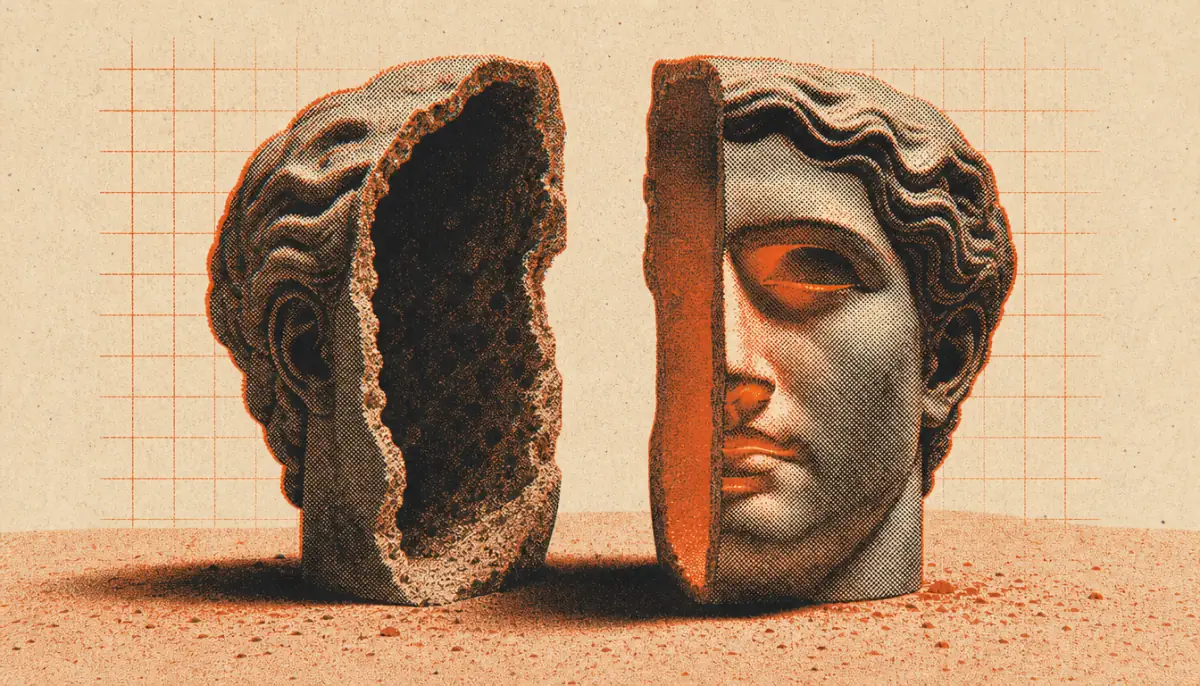
The Greek word pathos did not mean “emotion” in the modern sense. It meant something closer to a passion that happens to you. A pathos is a movement of the soul that overrides judgment, a surge that carries you somewhere you did not choose to go. The Latin translation, perturbatio, captures it better: a disturbance, a disordering of the mind.
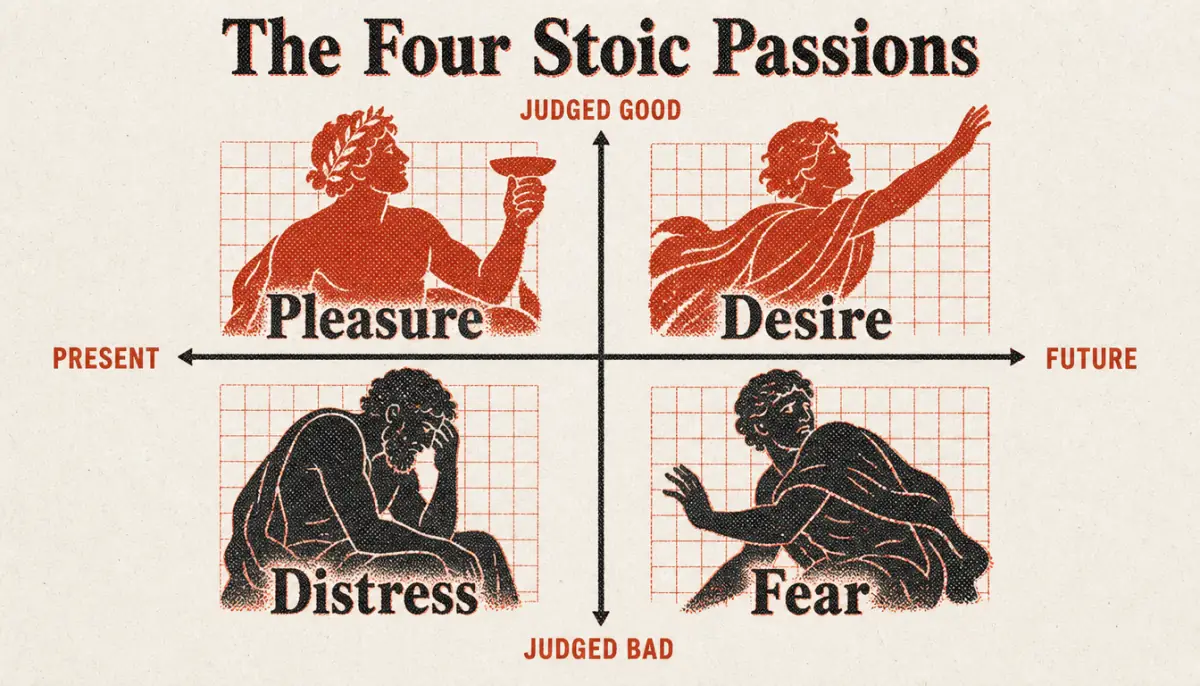
The Stoics organized these disturbances around two axes: whether the object is present or anticipated, and whether it is judged good or bad. That gives four primary passions.
- Desire (craving for a future thing judged good)
- Fear (aversion to a future thing judged bad)
- Pleasure (elation over a present thing judged good, in the shallow, grasping sense)
- Distress (pain over a present thing judged bad)
Apatheia means the absence of these four. Not the absence of feeling. The absence of being governed by these four.
The diagram below maps the four Stoic passions and shows how each one connects to the judgment underneath it.
Why the Stoics Treated Passions as Judgments
Here is the mechanism that makes apatheia possible rather than fantasy. The Stoics held that a passion is not a raw physical event but an assent to a false judgment about value.
Take fear of losing your job. The raw event is the impression: your manager schedules an unexplained meeting. Then comes the judgment: “this is catastrophic, my worth depends on this position, if I lose it I am finished.” The passion of fear follows from that judgment. Change the judgment and the passion changes with it.
This is why the Stoics thought apatheia was trainable rather than a lucky temperament. You cannot control the first impression, but you control whether you sign off on it. Epictetus built his entire teaching practice around that gap.
The Part Almost Everyone Skips: Eupatheia
The Stoics did not stop at subtraction. They described a category of good affective states, eupatheiai, that belong to the well-governed mind:
- Joy (chara), the rational response to genuine good, which for the Stoics means virtue and virtuous action
- Caution (eulabeia), the rational counterpart to fear, which avoids genuine harm without panic
- Wish (boulēsis), the rational counterpart to craving, a considered want rather than a compulsion
A man in a state of apatheia still feels. He feels joy at his children’s growth, caution before a bad deal, a clear want for the work he was built to do. What he no longer does is thrash. The Stoic sage was described as cheerful, not blank.
Apatheia vs. Apathy: The Confusion That Ruins the Concept

English borrowed the word and gutted it. “Apathy” now means not caring. Apatheia means caring about the right things and refusing to be destabilized by the rest. The difference shows up in behavior, which is where any philosophy either proves itself or collapses.
| Dimension | Apatheia | Apathy |
|---|---|---|
| Relationship to values | Values are clear and held firmly | Values are absent or abandoned |
| Action | Decisive, engaged, follows through | Withdrawn, passive, avoids |
| Emotional range | Full range, without being overrun | Flattened, numb |
| Source | Trained judgment | Exhaustion, defeat, or avoidance |
| Effect on others | Steadying presence | Draining absence |
| Response to injustice | Acts within its power | Shrugs |
The Stoics were not withdrawn men. Cato held the line against Caesar at enormous personal cost. Seneca ran imperial correspondence. Marcus Aurelius governed an empire through plague and war. Epictetus taught until his body gave out. Apatheia was the internal condition that let them stay in the fight without the fight eating them.
Apatheia in Practice: Three Concrete Cases

Abstraction is where most Stoic content dies. Here is the concept at ground level.
Case 1: Criticism in a Meeting
A colleague dismisses your proposal in front of the room, with a tone that carries contempt.
Passion-driven response: Heat in the chest, a sharp reply, or silence followed by three days of replaying the exchange. The underlying judgment: “my standing has been damaged, this is an attack on me, I have been diminished.”
Apatheia response: Notice the impression. Separate the content from the delivery. Ask whether the objection has merit. If it does, take it. If it does not, answer the substance without addressing the tone. The underlying judgment: “another man’s opinion of my proposal is outside my control and does not touch my character. Whether I respond well is inside my control and does.”
Nothing here requires you to feel nothing. You will feel the heat. Apatheia is the second beat, not the first.
Case 2: Being Left
A relationship ends and you did not choose it.
Passion-driven response: Grief that metastasizes into obsession. Rehearsed arguments. Scrolling her feed at 1am. The judgment: “this person was necessary to my life being good, and without her my life cannot be good.”
Apatheia response: Grief, genuinely felt, because loss is real and the Stoics never pretended otherwise. But the grief does not become identity. The judgment: “I loved something outside my control and it left, as everything outside my control eventually does. My capacity to love well, act well, and rebuild is intact.”
Epictetus was blunt about this pattern. He compared attachment to loved ones to holding a cup that can shatter: love it fully, and know what it is. That is not coldness. It is refusing to lie to yourself about the terms of the arrangement.
Case 3: A Setback You Caused
You made a decision that cost money, time, or standing, and it was your call.
Passion-driven response: Self-loathing that looks like accountability but produces no correction. The judgment: “I am the kind of man who ruins things.”
Apatheia response: A clear accounting of what went wrong, what you would change, and what you cannot recover. Then movement. The judgment: “I judged poorly. Judgment improves through correction, and self-punishment is not correction.”
Here is the contrast in condensed form.
| Situation | Governed by judgment (apatheia) | Governed by passion |
|---|---|---|
| Public criticism | Answers the substance, ignores the tone | Retaliates or ruminates for days |
| Rejection | Feels it, then keeps moving | Pursues, pleads, or shuts down entirely |
| Financial loss | Audits the decision, adjusts the system | Chases losses or freezes on all decisions |
| Insult from a stranger | Costs nothing, requires no response | Escalates to protect an image |
| Delayed recognition | Keeps the standard, keeps working | Resents, complains, quietly withdraws effort |

Common Misreadings of Apatheia
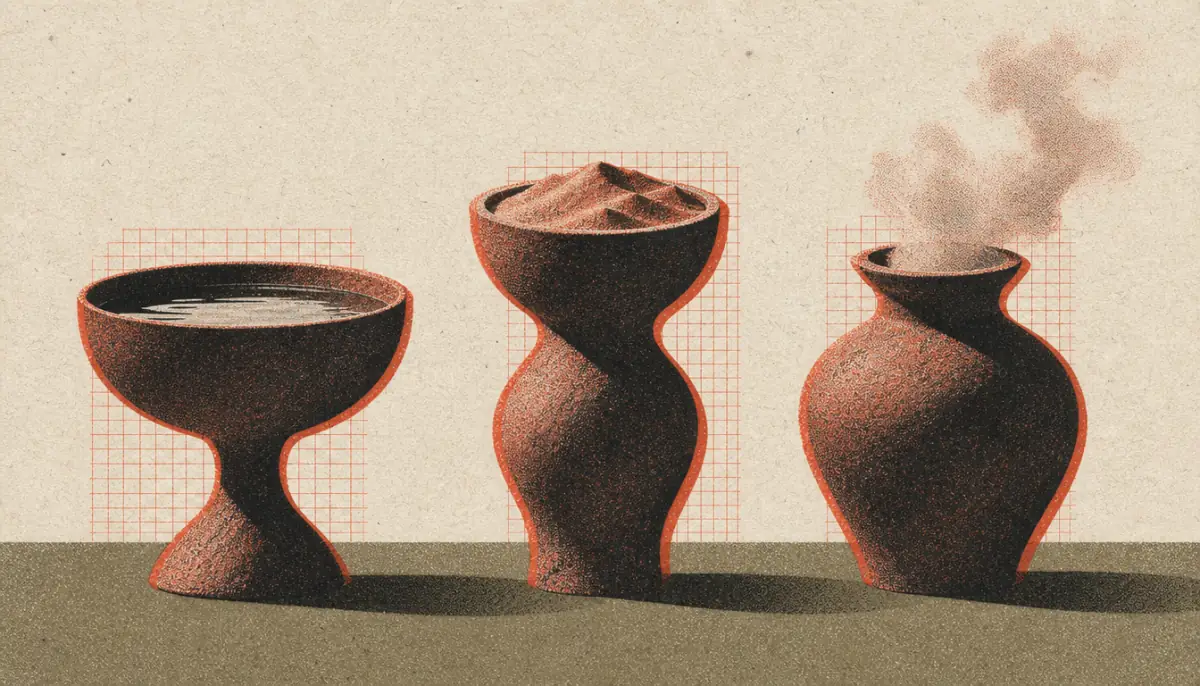
Because the word carries so much baggage, the concept gets bent into shapes the Stoics would not recognize. Four distortions do most of the damage.
| Misreading | Accurate understanding |
|---|---|
| ”Apatheia means feeling nothing” | It means not being ruled by destructive passions. Eupatheiai, the rational good feelings, remain and are cultivated. |
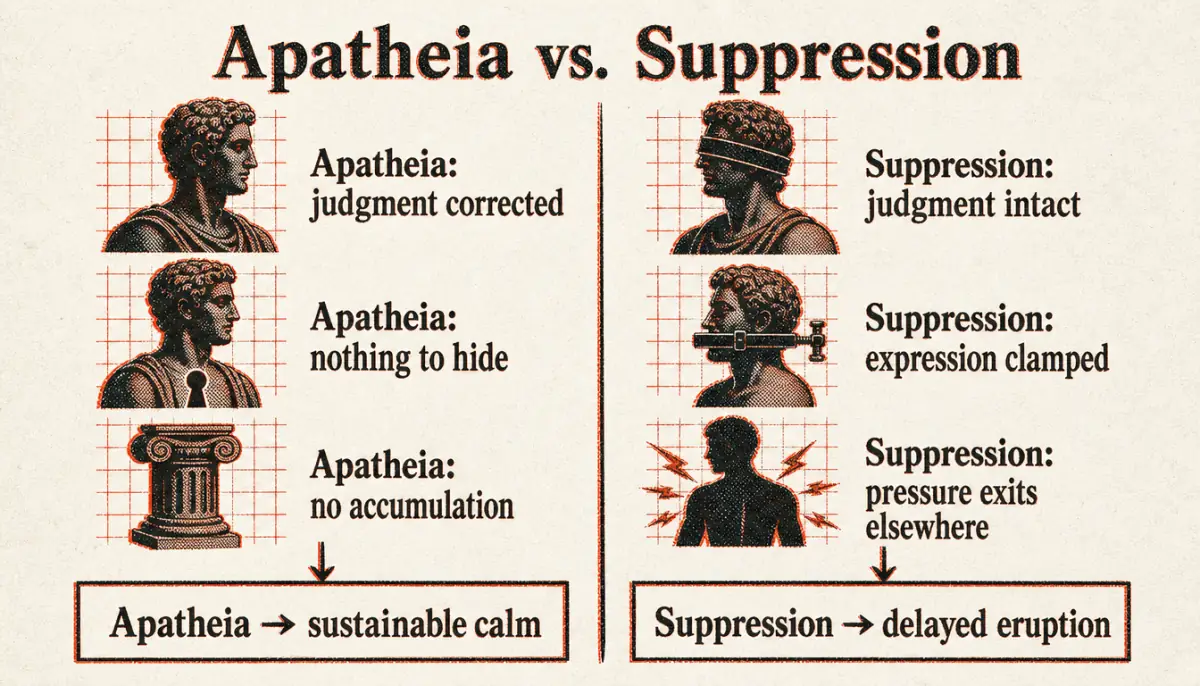
| ”Apatheia is emotional suppression” | Suppression is feeling the passion and hiding it. Apatheia works upstream, by correcting the judgment that generates the passion in the first place. |
| ”Apatheia means you stop caring about people” | Stoic ethics builds outward from oikeiosis, natural affinity, to duty toward family, community, and humanity. Detachment from outcomes is not detachment from people. |
| ”Achieving apatheia makes you invulnerable” | The Stoics described the sage as a limit case, rarely if ever fully realized. Apatheia is a direction of travel, not a badge you collect. |
| ”Apatheia means accepting everything passively” | It removes the internal turbulence that degrades action. The Stoics argued vigorously for engaged political and civic duty. |
The Suppression Trap Deserves Extra Attention
This is the failure mode most men fall into, and it is worth naming precisely. Suppression means you still judge the insult as damaging, the loss as catastrophic, the criticism as an attack, and then you clamp down on the outward expression. The judgment stays intact. The pressure builds. It exits somewhere else, usually at the people who have the least to do with it.
Apatheia attacks the judgment. If you stop believing that another man’s contempt diminishes you, there is no pressure to suppress. Nothing accumulates. A man who looks calm while grinding his teeth has not achieved apatheia. He has built a pressure vessel.
The comparison below shows where suppression and apatheia diverge.
Apatheia and Its Neighbors: Ataraxia, Detachment, Equanimity

Several terms circle the same territory and get used interchangeably online. They come from different systems and mean different things.
| Term | Meaning | How it differs from apatheia |
|---|---|---|
| Ataraxia | Untroubledness, tranquility. Central to Epicureanism and Pyrrhonism. | Ataraxia is the absence of disturbance as a goal in itself. For the Stoics, tranquility is a byproduct of virtue, not the target. |
| Eupatheia | The rational good feelings: joy, caution, considered wish. | Not a rival to apatheia but its positive content. Apatheia clears the ground; eupatheia is what grows there. |
| Buddhist non-attachment | Release from clinging as a route out of suffering. | Similar practical texture, different metaphysics. Stoicism affirms engaged duty in a rationally ordered cosmos rather than release from the cycle of rebirth. |
| Equanimity | General modern term for a steady mind under pressure. | Broader and looser. Apatheia is a specific technical claim about passions being false judgments. |
| Stoic indifferents (adiaphora) | Things neither good nor bad in themselves: wealth, health, reputation. | Adiaphora classifies external things. Apatheia describes your internal state toward them. |
| Emotional intelligence | Recognizing and managing emotions, yours and others’. | Largely descriptive and skills-based. Apatheia is prescriptive and rests on a theory of value. |
The Adiaphora Connection Is the Load-Bearing One
You cannot understand apatheia without the doctrine of indifferents. The Stoics held that only virtue is good and only vice is bad. Everything else, your salary, your health, your reputation, whether your father approved of you, falls into the category of indifferents.
That does not mean these things are worthless. The Stoics distinguished preferred indifferents (health, wealth, good reputation) from dispreferred ones. You rationally pursue the preferred ones. You just do not stake your moral condition on getting them.
This is where apatheia becomes structurally possible. If your worth as a man is not contingent on external outcomes, then external outcomes cannot destabilize your worth. The four passions all depend on treating indifferents as though they were genuine goods and evils. Correct that error and the passions lose their fuel.
Training Toward Apatheia: A Practical Framework
Understanding apatheia costs you an afternoon. Building it costs you years. The Stoics were explicit that this was a training discipline, not an insight. Epictetus described three fields of training, and they remain the clearest structure available.
The Three Disciplines
- The discipline of desire (what to want and what to avoid). Training yourself to want only what is within your power, and to accept what is not. This is the direct assault on craving and fear.
- The discipline of action (how to behave toward others). Training yourself to act according to your roles and duties regardless of how you feel or how others behave. This is where apatheia becomes social presence rather than private calm.
- The discipline of assent (what to believe). Training yourself to examine impressions before agreeing with them. This is the foundational one, because it is where passions are born.
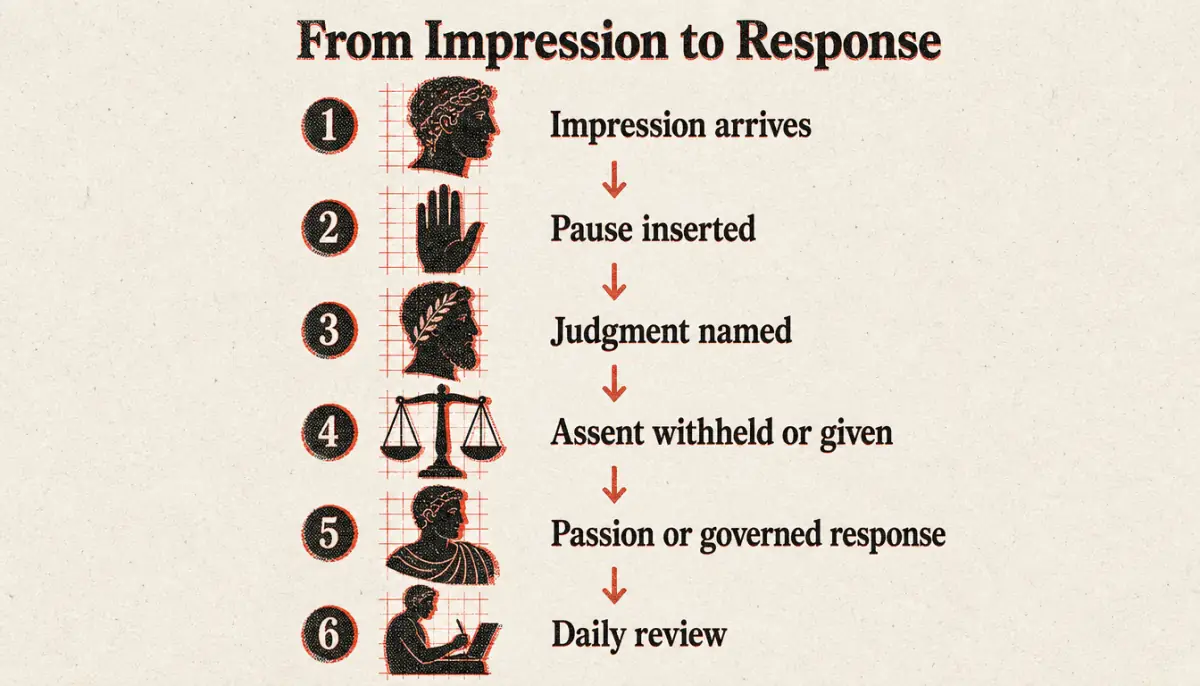
The sequence below shows how an impression becomes either a passion or a governed response.
Four Practices That Do the Actual Work
1. Interrogate the impression before you assent. When something hits you, insert a pause and name the judgment underneath the feeling. Not “I’m angry” but “I am judging that this man’s disrespect diminishes me.” Stated that plainly, most of these judgments look absurd, which is the point. The pause is short, a few seconds, but it has to become habitual.
2. Run the dichotomy on everything. For any situation producing turbulence, split it into what you control and what you do not. Your effort, your response, your standards, your honesty: yours. Outcomes, other people’s reactions, the economy, the past: not yours. Then withdraw investment from the second column. This sounds mechanical because it is. That is why it works under pressure.
3. Practice premeditation of adversity. Before a hard conversation, a negotiation, a competition, spend a few minutes imagining it going badly. Not to be pessimistic, but to strip the shock value out of the outcome. Passions feed on surprise. A man who has already rehearsed the loss does not get knocked over by it.
4. Review the day’s assents. At the end of the day, audit where you were governed by passion. Where did you react rather than respond? What judgment were you holding? What would the accurate judgment have been? Seneca described this practice, and it converts vague aspiration into a feedback loop. Without a review mechanism, you will repeat the same errors for a decade and call it experience.
What Progress Looks Like
You will not wake up unshakeable. Progress shows up in specific, measurable ways:
- The gap between impression and reaction lengthens. You get a second where you used to get none.
- Recovery time shortens. An insult that used to cost you a day costs you twenty minutes.
- Your behavior becomes more predictable to the people around you, and they start relying on it.
- You stop needing other people’s agreement to act on your own judgment.
- Decisions get made on their merits rather than on how you feel that morning.
That last one is the practical payoff most men are actually after. The value of apatheia is not serenity for its own sake. It is that a mind free from turbulence makes better decisions, keeps its commitments, and can be depended on. That reliability compounds into everything else: the quality of your work, the trust of your friends, the security your family feels around you, what remains of you after you are gone.
Where the Discipline Usually Breaks
Three failure patterns show up repeatedly.
The first is using apatheia as a shield against intimacy. Detachment from outcomes gets redirected into detachment from people, because that is easier and it sounds philosophical. If your practice is making you a worse friend, partner, or father, you are doing something other than Stoicism.
The second is performing calm rather than building it. This is suppression wearing a toga. The test is whether the pressure exits somewhere else later.
The third is treating apatheia as a destination and quitting when you find you have not arrived. The Stoics called themselves prokoptontes, those making progress. Even Seneca, writing to Lucilius, described himself as a patient rather than a physician. Assume permanent construction.
Key Takeaways
- Apatheia means freedom from destructive passions, not the absence of emotion. The Greek pathos referred to a disturbance that overrides judgment, not to feeling in general.
- The four passions are desire, fear, pleasure, and distress, and each one rests on a false judgment about what is genuinely good or bad.
- Eupatheia is the other half of the doctrine. Joy, caution, and considered wish are the rational feelings that belong to a well-governed mind.
- Apatheia is not suppression. Suppression hides the reaction while leaving the judgment intact. Apatheia corrects the judgment so there is nothing to hide.
- It rests on the doctrine of indifferents. Only virtue is good, which is what makes external outcomes unable to destabilize your character.
- It is trained, not discovered. Epictetus’s three disciplines of desire, action, and assent give the structure; the daily review gives the feedback loop.
If you want to go further, the next concepts to study are the dichotomy of control, which is the engine behind the discipline of desire, and prohairesis, the Stoic account of the faculty of choice that they considered the only thing truly yours. Both sit underneath apatheia and explain why the Stoics thought it was achievable rather than aspirational.