
Stoicism vs. Buddhism: Two Paths to Mastering the Mind, Compared
Stoicism and Buddhism both train the gap between stimulus and response, but they enter through different doors and demand different things on day one. This comparison breaks down both systems across speed to results, depth of transformation, compatibility with ambition, and daily practicality,…
Contents
If your primary problem is reacting badly to a world you cannot control, start with Stoicism. If your primary problem is a mind that will not stop generating noise, start with Buddhism. Both traditions end up training the same faculty, the gap between stimulus and response, but they enter through different doors and they ask different things of you on day one.
That is the short answer. The longer answer matters because most men who read a few Marcus Aurelius quotes or download a meditation app are not failing from lack of information. They are failing because they picked a framework that does not match the specific way their mind breaks down under pressure. Diagnosis before prescription.
What follows is a structured comparison of the two systems across the dimensions that actually determine whether a philosophy survives contact with your Tuesday morning.
The Basic Profile of Each Tradition

Before comparing mechanics, it helps to fix the basic coordinates of each system. These are not interchangeable self-help brands. They emerged from different civilizations, answered different questions, and carry different assumptions about what a human being is for.
| Stoicism | Buddhism | |
|---|---|---|
| Origin | Ancient Greece, later Rome | Ancient India, later spread across Asia |
| Founding figures | Zeno of Citium; later Seneca, Epictetus, Marcus Aurelius | Siddhartha Gautama, the Buddha |
| Core diagnosis | Suffering comes from judging things outside our control as good or bad | Suffering comes from craving and attachment rooted in misperception |
| Core goal | Virtue, living in accordance with nature and reason | Liberation from suffering, awakening |
| Primary method | Rational examination of judgments, disciplined action | Meditation, ethical conduct, cultivation of insight |
| Relationship to society | Deeply engaged, duty to the city and family | Ranges from monastic withdrawal to lay engagement |
| Metaphysics | Rational, ordered cosmos; a divine logos | No permanent self; everything conditioned and impermanent |
The last row is where the two systems genuinely part ways. Stoicism assumes you have a rational faculty, a commanding part of the mind, that can be strengthened and relied upon. Buddhism investigates that same faculty and concludes there is no fixed self there at all, only a process. One tradition builds a fortress. The other examines whether the walls were ever solid.
For practical purposes, both produce men who do not flinch. They just get there differently.
Stoicism vs Buddhism: The Comparison at a Glance

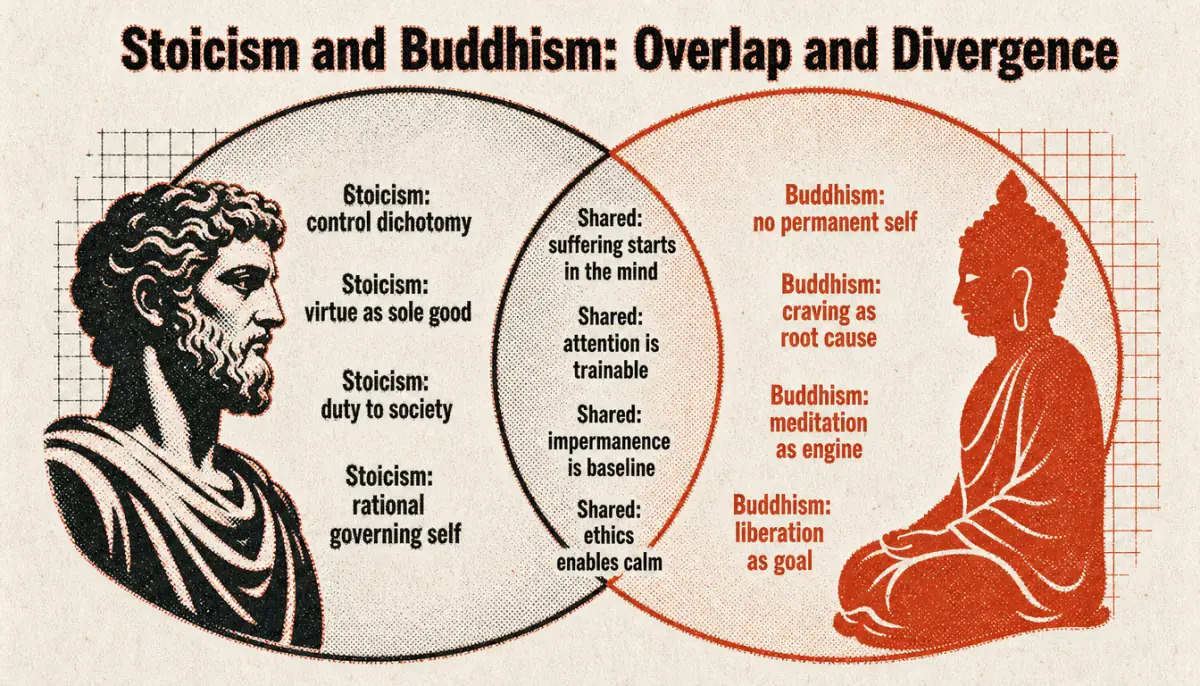
Here is the summary view across the dimensions that matter most to someone deciding where to invest his attention. The diagram below maps how the two traditions overlap and where they diverge.
| Dimension | Stoicism | Buddhism | Edge |
|---|---|---|---|
| Speed to first result | Fast; a single reframe can change a day | Slower; requires sustained practice before shifts land | Stoicism |
| Depth of transformation | Strong at behavior and judgment | Reaches underlying perception itself | Buddhism |
| Fit with ambition and career | Built for men with responsibilities and public roles | Ambivalent toward worldly striving | Stoicism |
| Handling grief and loss | Preparation and acceptance through reason | Direct investigation of attachment itself | Buddhism |
| Emotional regulation under pressure | Interrupt the judgment, kill the emotion at the root | Observe the emotion without fusing with it | Tie |
| Practical daily structure | Journaling, morning and evening review, negative visualization | Sitting meditation, precepts, mindfulness throughout the day | Tie |
| Accessibility without a teacher | Primary texts are direct and readable | Meditation instruction benefits enormously from guidance | Stoicism |
| Community and support | Mostly informal, online, book-based | Established sanghas, retreat centers, teacher lineages | Buddhism |
Stoicism wins on speed and compatibility with an ambitious life. Buddhism wins on depth and on the quality of its training infrastructure. Neither wins outright, which is why the rest of this comparison breaks each dimension down rather than declaring a champion.
Where the Two Systems Diverge

Speed to First Result
Stoicism gives you something usable within an hour of reading. Epictetus draws one line: some things are up to us, some are not. Your opinions, impulses, desires, and aversions are yours. Your body, reputation, and office are not. Apply that single distinction to the thing currently eating at you and the emotional charge drops measurably.
A man who loses a promotion can run the Stoic operation on the spot. Was the decision in my control? No. Was my preparation in my control? Yes, and I executed it. Then the loss is external and my response to it is the only thing carrying moral weight. That reframe is available immediately, without training.
Buddhism offers no equivalent instant lever. Meditation produces its returns on a different curve. The first weeks of sitting often feel worse than not sitting, because you are getting an unfiltered look at how loud your mind actually is. Most men quit here. Those who do not report that somewhere past the initial months, something shifts in how thoughts arrive, and the shift is more durable than any reframe.
The tradeoff is real. Stoicism pays fast and shallow at first. Buddhism pays slow and deep. If your current state is chaotic enough that you need a win this week to keep going, take the Stoic lever.
Depth of Transformation
Stoic practice works at the level of judgment. An event occurs, you form an impression, and the impression carries an implicit verdict: this is bad. Stoicism teaches you to catch the verdict and interrogate it before you assent. That is powerful. It is also a repeated act of correction, applied indefinitely.
Buddhist practice aims lower in the stack. Instead of correcting the verdict, it investigates the machinery that produces verdicts. Insight practice examines the arising of a thought, the sense of a thinker behind it, and the felt solidity of the self that claims ownership of the whole process. When that examination goes deep enough, certain reactions stop arising rather than getting corrected.
Consider anger at a colleague who undermined you. The Stoic response: his behavior is external, my character is internal, I will not let his vice corrupt my virtue. This works, and it works reliably, but you run the operation every time the anger surfaces.
The Buddhist response works on the anger itself as a sensation arising in awareness, unowned, impermanent, and already dissolving while you observe it. Run that enough times and the anger loses its grip because you stop identifying with it as yours.
Depth is not automatically better. Depth takes years. Correction takes seconds. A man who needs to function well tomorrow should not chase depth at the expense of function.
Fit With Ambition and Worldly Responsibility
This is where the gap widens most for the ambitious man, and where most casual comparisons go wrong.
Stoicism was built by and for people running things. Marcus Aurelius governed an empire while writing his private notes. Seneca advised an emperor and managed significant wealth. Cato led armies and factions. The Stoics held that engagement with public life is a duty, not a distraction. Withdrawing from your obligations to protect your peace was, in their view, a failure of character.
Stoicism’s concept of preferred indifferents makes this coherent. Wealth, health, status, and reputation are not good in themselves, but they are naturally preferable and worth pursuing, provided you never mistake them for the actual good. You can chase the promotion hard, lose it, and remain intact, because your worth was never staked on it.
Buddhism has a more complicated relationship with ambition. The founding narrative involves a prince abandoning a kingdom. Craving is named as the engine of suffering, and worldly striving is craving with a respectable job title. Monastic traditions institutionalize renunciation.
Lay Buddhist traditions do reconcile practice with work, family, and building something. Right Livelihood is part of the Eightfold Path, which assumes you have a livelihood. But the pull toward non-attachment can become an excuse for not trying, and a man who already struggles with follow-through should notice that risk.
If your work is a significant part of your identity and you intend to keep it that way, Stoicism will fight you less.
Handling Grief, Loss, and Mortality
Both traditions stare directly at death. Neither offers comfort through denial.
The Stoic method is preparation. Premeditatio malorum, the premeditation of evils, has you rehearse loss before it arrives. You imagine your work destroyed, your reputation gone, the people you love no longer here. Not to be morbid, but to strip the event of its shock value. Epictetus advised that when you kiss your child goodnight, you remind yourself she is mortal. Harsh in phrasing. Effective in practice, because it converts the unthinkable into the contemplated.
The Buddhist method is investigation of attachment itself. Grief is examined as a process, not braced against as an event. Traditional practices include contemplation of the body’s decay, deliberately and in detail. The goal is not toughness but the direct recognition that everything held is already leaving, which loosens the grip that makes loss unbearable.
In lived experience, the Buddhist approach tends to leave more room for the emotion. Stoicism can be misread as a demand to not feel, which produces men who are suppressing rather than processing. The Stoics themselves did not teach suppression. Seneca wrote openly about grief and allowed it. But the texts are easy to misread in that direction, and many readers do.
Emotional Regulation Under Live Pressure
Both systems work here, through different mechanisms, and this is the cleanest tie in the comparison.
Stoic regulation is upstream. Emotion follows judgment, so you attack the judgment. Someone insults you in a meeting. The insult is sound in the air. The distress comes from your verdict that the insult damages something real. Withdraw the verdict, the distress does not form. The Stoic goal is to prevent the emotion from being constructed rather than manage it after it exists.
Buddhist regulation is concurrent. The emotion arises, and you meet it with awareness rather than identification. Anger appears as heat in the chest, tightening in the jaw, a narrative running in the head. You observe all of it without becoming it. The emotion completes its cycle without commandeering your behavior.
The Stoic approach is stronger when you have a second to think. The Buddhist approach is stronger when the reaction has already fired and you need to not act on it. Most men need both, which is why the skills stack well.
Daily Structure and Practicality
Stoic practice is compact and fits into an existing schedule. The standard shape:
- Morning preparation: anticipate what will go wrong and who will behave badly, and decide in advance how you will meet it
- Continuous attention: throughout the day, catch impressions before assenting to them
- Evening review: examine the day’s actions, name what you did poorly, commit to the correction
- Periodic voluntary discomfort: cold, hunger, hard physical effort, deliberately chosen
None of that requires a separate block of time. It layers onto a normal day.
Buddhist practice usually requires a carved-out block. Sitting meditation asks for dedicated minutes, ideally at a consistent time, ideally daily. Mindfulness extends into ordinary activity, but the formal sit is the engine. Add the precepts as ethical constraints and periodic retreats for depth, and it becomes a structural commitment rather than an overlay.
The advantage of the Buddhist structure is that it is harder to fake. You either sat or you did not. Stoic practice, being mostly cognitive, can be quietly abandoned while you still describe yourself as a Stoic. Plenty of men have read the Meditations three times and changed nothing.
Learning Without a Teacher
Stoicism transmits well through text. The core works were written as letters, lecture notes, and private journals, all addressed to ordinary people dealing with ordinary problems. They are readable without a translator of the ideas. A man can pick up Epictetus and apply something that afternoon.
Buddhism is harder to self-teach at depth. Meditation instruction has failure modes that are difficult to detect from the inside. You can practice consistently for a year and cultivate subtle dullness, or strain, or spiritual bypassing, and never know. Traditional lineages exist partly to catch those errors. Written instruction has improved considerably, but the ceiling on self-guided practice is lower.
Community and Continuity
Buddhism has infrastructure. Sangha is one of the three refuges, treated as essential rather than optional. Retreat centers, resident teachers, and lineages spanning centuries exist in most large cities. If you want to practice with other people and be held accountable by them, the path is walkable.
Stoicism has no equivalent institution. The ancient schools are gone. What exists is informal: reading groups, online forums, annual gatherings, and an enormous amount of solitary reading. For a self-directed man this is fine. For a man who needs external structure to sustain anything, the absence is a genuine problem, and the honest solution is to build your own accountability rather than pretend you do not need it.
What the Two Traditions Share

The overlap is substantial enough that scholars have argued about influence for over a century. Whether or not the traditions touched historically, they converge on several conclusions.
External events do not directly cause suffering. Both locate the source in the mind’s relationship to events, not the events themselves. This single premise separates both from most modern approaches to wellbeing, which try to arrange conditions favorably.
Attention is the trainable faculty. Neither tradition asks you to change your circumstances first. Both train what you notice, how quickly you notice it, and what you do in the moment after noticing.
Impermanence is the baseline fact. Marcus Aurelius returns to it constantly, the river, the ashes, the forgetting. Buddhism names it as one of the three marks of existence. Both treat the refusal to accept it as the source of most unnecessary pain.
Ethics is not separate from mental training. Both traditions reject the idea that you can have a calm mind and a corrupt character. Stoicism makes virtue the only good. Buddhism makes ethical conduct a prerequisite for meditative depth. Neither offers peace as a standalone product.
Desire requires examination. Stoicism restricts desire to what is within your control. Buddhism investigates craving as the mechanism of suffering. Different vocabularies, similar target.
The work is daily and unfinished. No arrival point in either system that lets you stop practicing. Both describe philosophy as an ongoing exercise rather than a body of knowledge you acquire and own.
A man who practices either seriously ends up with the same set of capacities: the ability to stay steady when conditions deteriorate, the ability to notice a reaction before it becomes behavior, and a working relationship with mortality. The processes differ. The output overlaps heavily.
Which One Fits Your Situation

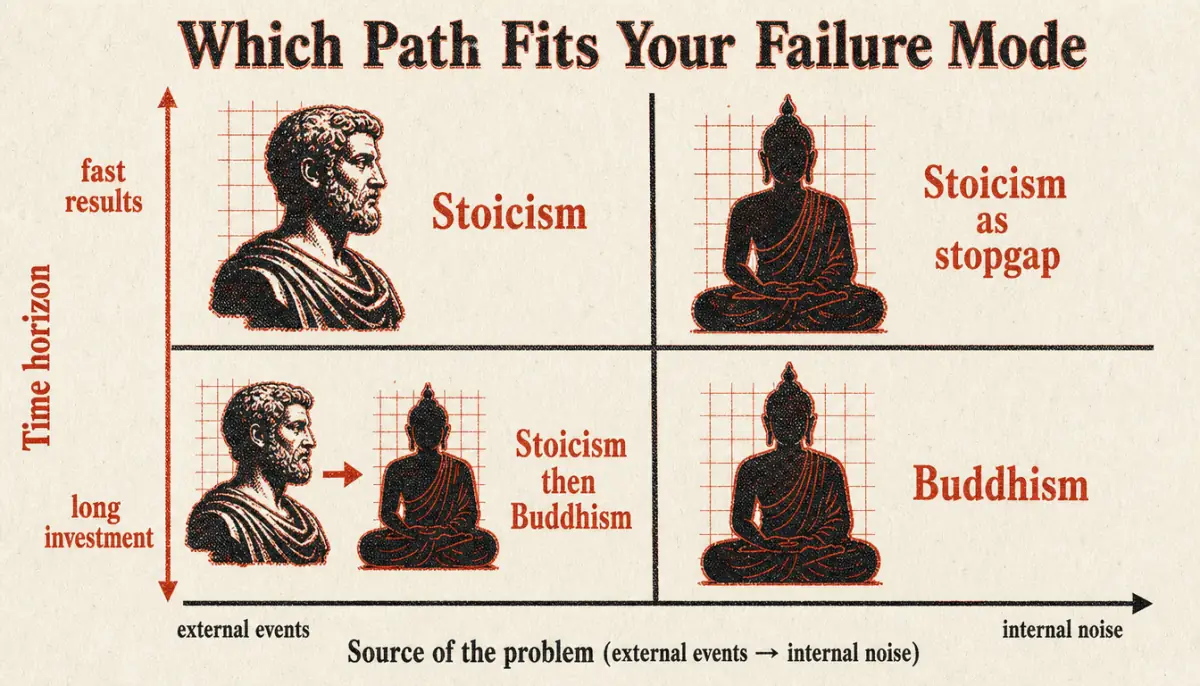
Pick based on your dominant failure mode, not on which tradition sounds more impressive. The decision logic below walks through the practical criteria.
| Your situation | Start with | Why |
|---|---|---|
| You overreact to setbacks at work and burn relationships | Stoicism | The control dichotomy gives you an immediate, usable interrupt for reactive anger and frustration |
| Your mind races constantly and you cannot switch off | Buddhism | Meditation trains the faculty of attention directly, which is the specific thing that is failing |
| You are building a career or business and need resilience without losing drive | Stoicism | Preferred indifferents let you pursue hard while staying unattached to outcomes |
| You are processing significant grief or loss | Buddhism | Investigation of attachment leaves room for the emotion rather than demanding you master it quickly |
| You have consumed self-improvement content for years without changing | Buddhism | Formal sitting is binary and unfakeable; you cannot intellectualize your way through it |
| You have limited time and need something that layers onto an existing schedule | Stoicism | Practice fits into commute, journal, and review without carving out a dedicated block |
| You need other people to hold you accountable | Buddhism | Sangha and retreat structures provide external accountability that Stoicism largely lacks |
The Case for Running Both
The two systems are not competing for the same slot. Many serious practitioners use Stoic framing for decisions and conduct, and Buddhist practice for training the attention that makes the framing possible.
The practical combination looks like this. You sit in the morning, building the capacity to notice a thought as a thought rather than as a command. Then you run your day on Stoic principles, applying the control dichotomy to every frustration and reviewing your conduct against your standards at night.
The meditation makes the Stoic work easier, because you cannot examine an impression you never noticed forming. The Stoic framework gives the meditation a direction, because sitting without an ethical structure produces calm people who still behave badly.
The one caution is doctrinal coherence. Stoicism and Buddhism make incompatible metaphysical claims. Stoicism posits a rational governing self in an ordered cosmos. Buddhism denies a permanent self. If you care about intellectual consistency, you will have to decide how to hold that tension. Most practitioners treat both as toolkits and move on, which is defensible as long as you are honest that you are doing it.
How to Begin Without Wasting Six Months

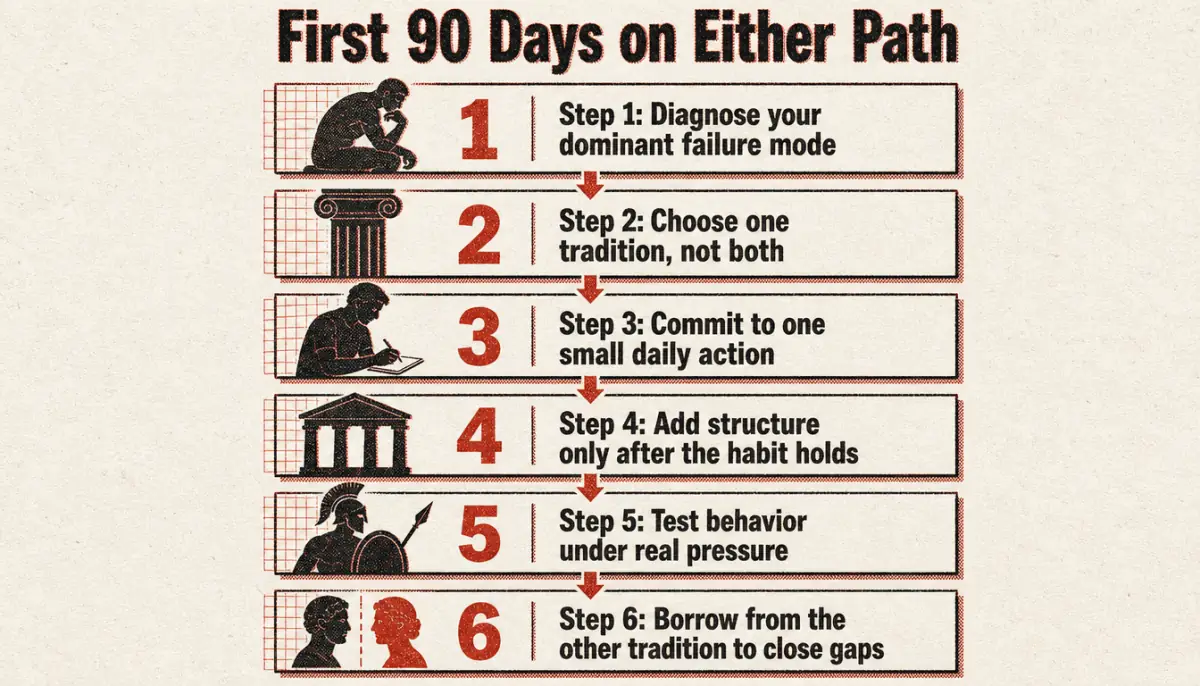
Knowing which tradition fits is useless without a first move. The sequence below removes most of the ways men stall out.
If You Chose Stoicism
- Read one primary source, not commentary. The Enchiridion of Epictetus is short and direct. Read it in one sitting, then again slowly.
- Pick one principle and apply it for two weeks. The control dichotomy is the obvious candidate. Every time you feel resistance, ask whether the thing you are resisting is yours to control.
- Start an evening review. Five minutes, written. What did I do badly today. What would I do differently. Nothing aspirational, only assessment.
- Add voluntary discomfort weekly. Cold shower, skipped meal, hard training session. Prove to yourself that discomfort is survivable before life proves it for you.
- Expand gradually. Add morning preparation once the evening review is habitual. Do not build the full system in week one.
If You Chose Buddhism
- Commit to a fixed, small daily sit. Ten minutes at the same time every day beats forty minutes three times a week. Consistency trains the habit; duration comes later.
- Get instruction from a human. A local group, a teacher, a structured course. Self-guided meditation has failure modes you cannot see from inside.
- Expect the first month to be unpleasant. You will meet how noisy your mind is. That is the practice working, not failing.
- Adopt the ethical constraints. The precepts are not decoration. Practice without ethical conduct plateaus quickly, and the tradition says so explicitly.
- Plan a retreat within the first year. Concentrated practice over consecutive days produces shifts that daily sitting alone rarely delivers.
Failure Modes to Watch For
Both paths have a signature way of going wrong, and both produce men who believe they are progressing.
The Stoic failure mode is intellectual collection. You accumulate quotes, you can define the four virtues, you have opinions about which translation is superior, and your behavior under pressure is identical to what it was three years ago. Stoicism is easy to perform and hard to practice. The test is not what you know. The test is what you did the last time someone humiliated you in front of colleagues.
The Buddhist failure mode is bypassing. You use non-attachment as cover for not engaging. You avoid the difficult conversation and call it equanimity. You do not pursue the thing you want and call it freedom from craving. Detachment that produces passivity is avoidance with better vocabulary.
Both failure modes have the same root: preferring the identity of a practitioner over the discomfort of practicing. Watch for it in yourself, and check your behavior rather than your self-concept.
The Final Verdict
Stoicism if you need to function better in a demanding life, fast, without abandoning ambition. Buddhism if you need to change how your mind operates at a deeper level and you have the patience for a slower curve.
For most men in their late twenties through mid forties, carrying career pressure, family obligations, and a nagging sense of falling short of what they could be, Stoicism is the more practical entry point. It was written by people in exactly that position. It does not ask you to reconsider whether ambition is legitimate before you can benefit. It hands you a working tool in the first chapter.
But if you have been reading Stoic material for a year and your temper is unchanged, the problem is not that you need more Stoicism. The problem is that you lack the attentional capacity to catch an impression before you have already assented to it. That capacity is what meditation builds, and Buddhism has the better training program for it.
The honest final position: start where your failure is loudest, go deep enough to see results, then borrow from the other tradition where your first choice leaves gaps. Neither tradition was designed to be consumed. Both were designed to be practiced until the practice becomes character.
The comparison only matters up to the point where you choose. After that, the only variable that counts is whether you do the work on the days you do not feel like it.