Body Language for Men: 12 Signals That Read as Grounded, Not Aggressive
Most body language advice for men produces a dominance display that reads as insecurity. This breakdown ranks 12 signals by sustainability, aggression risk, and how much internal work each requires, from stillness under attention to clean exits. You get the mechanics, the failure mode where each…
Contents
- The Short Answer: Three Signals That Do the Most Work
- How These Signals Were Selected and Ranked
- All 12 Signals at a Glance
- The 12 Signals in Detail
- Which Signals to Train First, Based on Your Actual Problem
- Why Dominance Displays Backfire
- Common Mistakes Men Make When Working on Presence
- Summary and How to Start
Most men who research body language end up performing a character. They learn to widen their stance, lower their voice, hold eye contact three seconds longer than feels natural, and then walk into a room broadcasting effort. Everyone reads it. The signal that lands isn’t confidence, it’s audition.
The problem is the source material. Popular advice on body language for men is built on dominance displays borrowed from primate research and sales training, which produce a man who looks like he’s competing for territory in a conference room. That reads as aggressive, or worse, insecure. Grounded presence works differently. It comes from stillness, economy of movement, and a nervous system that isn’t scanning for threat.
The Short Answer: Three Signals That Do the Most Work
If you change nothing else, change these three. They carry the majority of the effect and they’re the hardest to fake, which is exactly why they’re worth building rather than performing.
- Stillness under attention. When people look at you, do you adjust? Most men do something: touch their face, shift weight, check their phone, laugh to release pressure. The ability to be looked at without fidgeting is the single most reliable signal of a settled man. It requires no technique, only tolerance.
- Weight distributed evenly, spine stacked. Not chest-out military posture. Weight on both feet, ribcage over hips, head balanced rather than pushed forward. This is structural, not theatrical, and it changes your breathing, which changes your voice, which changes how people respond before you finish a sentence.
- Slowed transitions. The moment you stand, sit, turn, or reach for something is where anxiety leaks. Men who feel rushed move in jerks. Cutting your transition speed by roughly a third makes you read as deliberate without making you read as slow.
These three share a property worth naming. None of them is an addition. Each one is a subtraction: remove the fidget, remove the collapse, remove the rush. That’s the organizing principle behind everything below.
How These Signals Were Selected and Ranked
Body language advice fails for a predictable reason. It optimizes for how you look in a single moment rather than how you’re read across an hour. A power pose holds for eight seconds. A conversation holds for forty minutes. The signals that matter are the ones you can sustain while your attention is on something else.
Four criteria filtered the list, weighted by how much they predict real-world effect.
1. Sustainability (weight: highest)
Can you hold this while thinking about the actual conversation? A signal that requires conscious maintenance collapses the moment you get engaged in a topic or feel pressure. Anything on this list has to survive distraction. This criterion eliminated most of the classic advice, including deliberate mirroring and strategic touch.
2. Aggression risk (weight: high)
Does this signal read as grounded or as challenging? The same behavior lands differently depending on intensity. Held eye contact at moderate intensity reads as present. The same contact with a locked jaw and no blinking reads as a threat. Signals were scored on how much margin for error they carry before tipping into confrontation.
3. Nervous system dependence (weight: moderate)
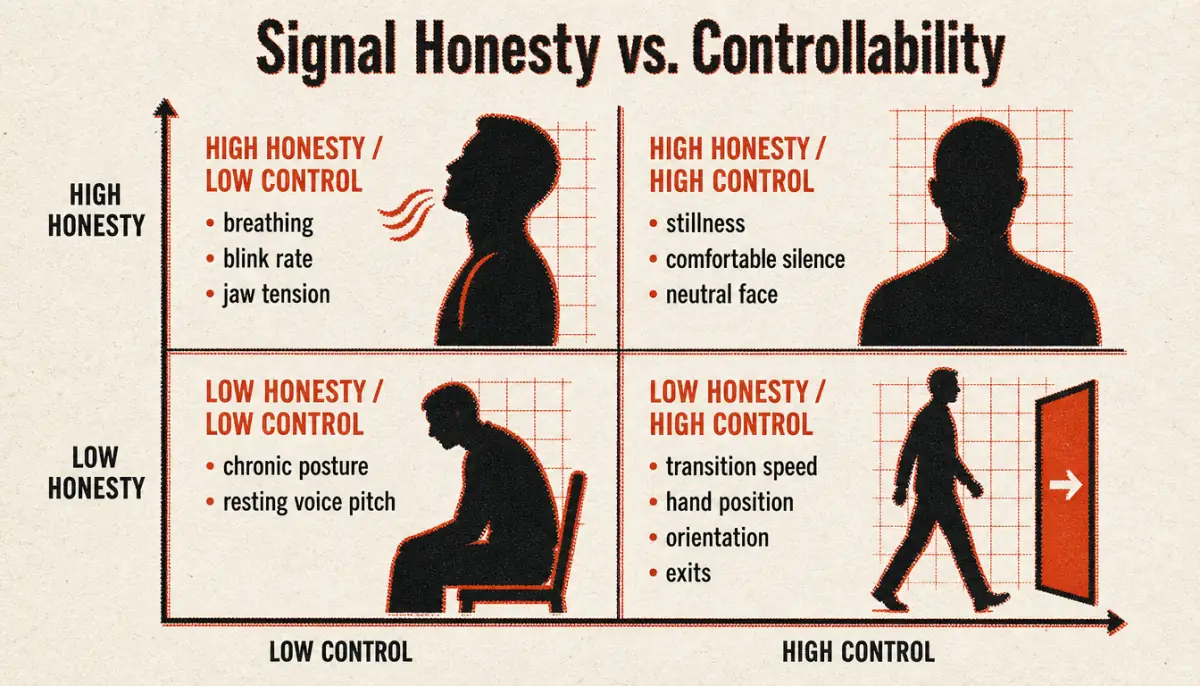
Some signals are downstream of physiology and cannot be faked for long. Breathing rate, blink rate, micro-tension in the hands and jaw. These rank high in honesty but low in immediate controllability, which means they’re training targets rather than quick wins. They’re included because the men who skip them stay stuck at the performance layer.
4. Cross-context portability (weight: moderate)
Does it work in a negotiation, at a bar, at a funeral, and in front of your kids? Context-specific tactics have their place but they’re not a foundation. Portable signals compound.
The diagram below maps the twelve signals against these two axes, honesty and controllability, so you can see which ones to train versus which ones to adjust immediately.
All 12 Signals at a Glance
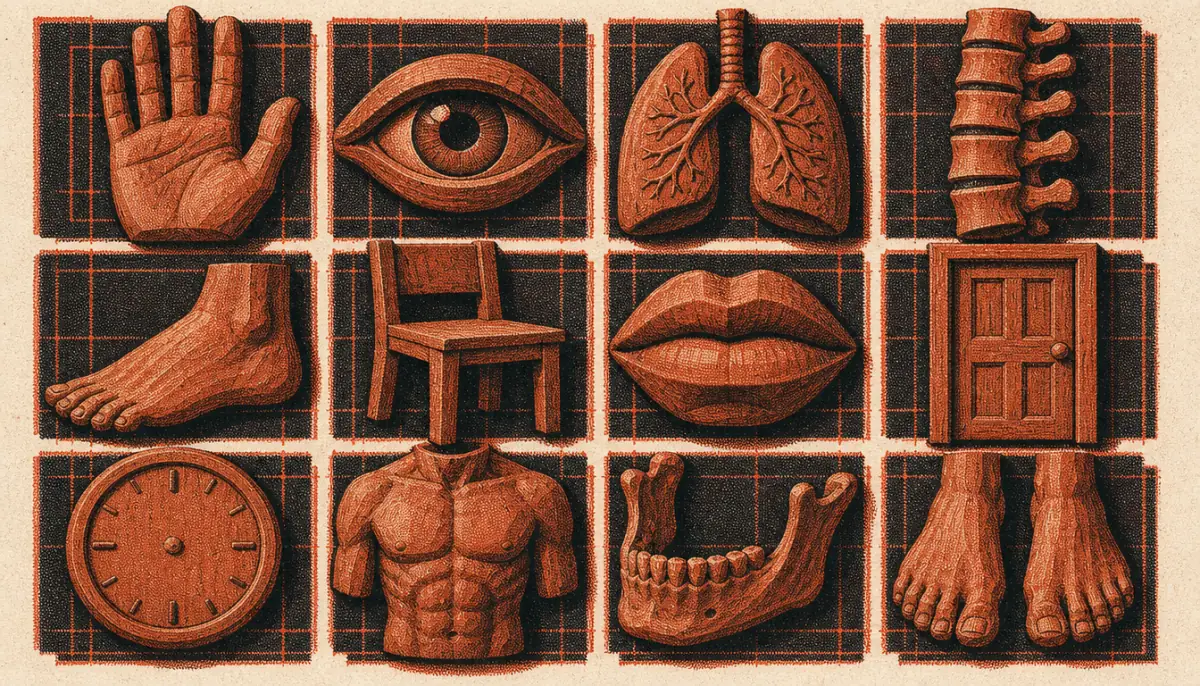
The table compares every signal across the dimensions that determine whether it’s worth your attention this month or next year.
| Signal | What It Actually Communicates | Difficulty | Priority |
|---|---|---|---|
| 1. Stillness under attention | Nothing here needs managing | High | Essential |
| 2. Stacked spine, even weight | Structural confidence, open airway | Moderate | Essential |
| 3. Slowed transitions | No urgency, no permission-seeking | Low | Essential |
| 4. Diaphragmatic breathing | Regulated nervous system | High | High |
| 5. Soft, steady gaze | Presence without challenge | Moderate | High |
| 6. Open, quiet hands | Nothing concealed, nothing gripped | Low | High |
| 7. Full-body orientation | Undivided attention | Low | High |
| 8. Unhurried speech onset | Words chosen, not spilled | Moderate | Moderate |
| 9. Comfortable silence | No need to fill space | High | Moderate |
| 10. Neutral resting face | Approval not required | Moderate | Moderate |
| 11. Grounded seated posture | Owning your space without sprawl | Low | Moderate |
| 12. Clean exits | Departure on your own terms | Low | Lower |
Difficulty reflects how much internal work the signal requires, not how complicated the mechanics are. Diaphragmatic breathing is mechanically simple and psychologically demanding, because shallow breathing is a symptom of something you haven’t resolved.
The 12 Signals in Detail
Each signal below includes the mechanics, what it actually communicates, the failure mode where it tips into aggression, and who should prioritize it.
1. Stillness Under Attention
Mechanics: When attention lands on you, change nothing. No hand to the face, no weight shift, no throat clear, no reach for a glass or phone. Let the attention arrive and sit there.
What it communicates: Attention is not a threat to you. Most men treat being observed as a problem requiring management, and the management is the tell. The fidget says the observation registered as pressure.
Failure mode: Rigidity. Frozen stillness with locked shoulders reads as a man bracing for impact, which is a different kind of tell. The distinction is muscular: grounded stillness has slack in the shoulders and jaw. If your traps are engaged, you’re freezing, not settling.
Advantages: Requires zero technique. Portable to every context. Hardest signal for others to consciously identify but the one that shapes their impression most.
Drawbacks: Cannot be shortcut. Builds only through repeated exposure to being watched without acting on the impulse to adjust.
Prioritize this if you catch yourself reaching for your phone the second a conversation pauses.
2. Stacked Spine, Even Weight
Mechanics: Weight split between both feet. Ribcage positioned over the pelvis rather than behind it. Head balanced on the neck, ears roughly over shoulders. Shoulders back and down by releasing the chest, not by pinching the shoulder blades.
What it communicates: Physical competence and unimpeded breathing. Forward head posture compresses the airway and thins the voice. Correct it and your voice drops without you trying to lower it.
Failure mode: The military chest. Puffed ribs, arched lower back, chin lifted. This reads as a man performing size, which observers correctly interpret as compensation.
Advantages: Downstream effects on voice, breathing, and perceived height. Improves with strength training, so it compounds with work you may already be doing.
Drawbacks: Chronic postural patterns take months to change. Cueing it consciously in the moment feels stiff until the underlying tissue adapts.
Prioritize this if you spend six or more hours a day at a desk.
3. Slowed Transitions
Mechanics: Standing up, sitting down, turning to face someone, reaching for an object, entering and leaving rooms. Take these at roughly two-thirds of your normal speed.
What it communicates: Nothing external is setting your tempo. Rushed transitions signal that you’re operating on someone else’s clock or trying to minimize the time you’re visible.
Failure mode: Theatrical slowness. Moving at half speed reads as either sedated or self-important. The adjustment should be imperceptible as an adjustment.
Advantages: Fastest signal to implement. Noticeable effect within a single day of deliberate practice.
Drawbacks: Easy to overdo. Inappropriate in genuinely urgent situations, where deliberate slowness reads as disengaged.
Prioritize this if people describe you as intense or wound up.
4. Diaphragmatic Breathing
Mechanics: Breath expands the belly and lower ribs rather than lifting the chest and shoulders. Exhale longer than the inhale. Nose breathing at rest.
What it communicates: A regulated nervous system. This is the root signal. Shallow chest breathing produces the fidgeting, the rushed speech, the tight jaw, and the darting eyes. Fix the breath and several other signals correct themselves.
Failure mode: Audible, performed breathing. Deep sighs in conversation read as impatience or condescension. The work is done before the conversation, not during it.
Advantages: Upstream of nearly everything else on this list. Trainable through direct daily practice.
Drawbacks: Breathing pattern reflects baseline stress load. If your life is genuinely dysregulated, breathwork manages the symptom while the cause remains. That’s worth knowing rather than ignoring.
Prioritize this if you notice your breath is shallow and high in your chest right now, reading this.
5. Soft, Steady Gaze
Mechanics: Look at the other person’s eyes with relaxed facial muscles. Blink normally. Break contact by looking to the side rather than down. When listening, hold contact more. When speaking, break it naturally as you think.
What it communicates: Presence without challenge. The variable that separates grounded from aggressive is not duration but muscular tension around the eyes and jaw.
Failure mode: The stare. Unbroken contact with a tight face and suppressed blinking is a dominance display, and most people respond to it with either hostility or discomfort. Breaking contact downward is the opposite failure, reading as submission or evasion.
Advantages: High impact on perceived trustworthiness. Works identically in professional and personal contexts.
Drawbacks: The most commonly overcorrected signal. Men who read about eye contact usually end up staring.
Prioritize this if you tend to look at foreheads, mouths, or over shoulders during conversation.
6. Open, Quiet Hands
Mechanics: Hands visible, palms not clenched, fingers relaxed. At rest, they hang at your sides or rest on a surface. No pocket-burying, no arm-crossing as a default, no object manipulation.
What it communicates: Nothing concealed, nothing gripped. Hidden or fidgeting hands read as either withholding or anxious, and observers register this without knowing why.
Failure mode: Gestural inflation. Large, frequent hand movements to add emphasis read as a man convincing rather than telling. Gesture should follow the thought, not sell it.
Advantages: Simple to observe in yourself. Immediate to correct.
Drawbacks: Hands are where residual anxiety surfaces first, so this signal reveals more than it fixes. That makes it a useful diagnostic.
Prioritize this if your hands are always holding something in social settings.
7. Full-Body Orientation
Mechanics: When someone addresses you, turn your torso and feet toward them, not just your head. When you disengage, turn your whole body away.
What it communicates: Undivided attention. Head-only turning is the physical equivalent of half-listening, and people feel the partial commitment even when they can’t name it.
Failure mode: Crowding. Full orientation combined with insufficient distance reads as pressure. Orientation and proximity are separate variables and should be managed separately.
Advantages: One of the few signals that measurably improves how others experience talking to you, not just how you’re perceived.
Drawbacks: In group settings, full orientation to one person visibly excludes others. Requires judgment about when partial orientation is the correct choice.
Prioritize this if people repeat themselves when talking to you.
8. Unhurried Speech Onset
Mechanics: When asked a question, pause for a beat before answering. Don’t begin with filler while your brain catches up. Let the silence hold for one or two seconds.
What it communicates: Your answer was chosen rather than produced under pressure. The instant response signals that speed mattered more to you than accuracy.
Failure mode: Weaponized pausing. A long, loaded silence before every answer reads as either condescension or a negotiating tactic. One beat, not four.
Advantages: Improves what you actually say, not only how you’re perceived. Reduces the amount you need to walk back later.
Drawbacks: Uncomfortable at first. Fast-paced group conversation punishes it, and you’ll lose some turns to speak.
Prioritize this if you frequently start sentences you don’t know how to finish.
9. Comfortable Silence
Mechanics: When a conversation pauses, don’t fill it. Let the gap exist. If the other person needs to think, give them the room.
What it communicates: The conversation’s survival is not your responsibility alone. Compulsive gap-filling signals that you’re managing the interaction, which means you’re anxious about it.
Failure mode: Withholding. Silence as a tool to make others uncomfortable is a manipulation, and people who’ve encountered it before will recognize it and resent it.
Advantages: Shifts conversational labor to a more even split. Makes other people reveal more.
Drawbacks: The hardest signal on the list psychologically, because the discomfort of silence is where most men’s social anxiety lives.
Prioritize this if you find yourself talking more than you intended in most conversations.
10. Neutral Resting Face
Mechanics: Default facial expression that is neither smiling nor scowling. Relaxed jaw, unfurrowed brow, mouth at rest. Smile when something is funny, not as a baseline.
What it communicates: Approval is not required. The persistent low-grade smile is an appeasement display, and it’s one of the most common patterns in men who’ve built careers on being agreeable.
Failure mode: The scowl. A tense, downturned neutral reads as hostile or unhappy and invites people to manage you. Genuine neutral has no muscular engagement at all, which is why it often requires releasing tension you didn’t know you were holding.
Advantages: Makes your genuine expressions carry weight. A smile that means something is worth more than a smile that’s always on.
Drawbacks: Can be misread as coldness during the transition period, particularly by people accustomed to your previous baseline.
Prioritize this if your face hurts after social events.
11. Grounded Seated Posture
Mechanics: Feet flat on the floor, both of them. Back against the chair or self-supported, not slumped forward onto the table. Arms resting rather than propping your head.
What it communicates: You occupy your allotted space without claiming more. Perched-forward seating reads as ready to flee or eager to please. The wide sprawl reads as a man performing ownership of a room he doesn’t own.
Failure mode: Territorial spread. Legs wide, arms over adjacent chairs, materials spread across the table. This is the most common form of body language for men that tips from grounded into aggressive, and it is consistently read as insecurity by anyone experienced.
Advantages: Meetings and meals are where most professional judgment happens, and this is the posture for both.
Drawbacks: Requires reasonable hip mobility. Poor chairs make it harder.
Prioritize this if most of your important conversations happen sitting down.
12. Clean Exits
Mechanics: When you decide to leave a conversation, say so and go. No trailing off, no gradual physical withdrawal, no waiting for permission or a natural break that may never come.
What it communicates: You direct your own movement. The lingering exit, where a man half-turns and sends increasingly obvious signals hoping to be released, communicates dependence on the other person’s cooperation.
Failure mode: Abruptness. Cutting someone off mid-sentence to leave is rude rather than grounded. A clean exit acknowledges the other person, then executes.
Advantages: Low difficulty, immediate effect, and it noticeably reduces your dread of entering conversations you’re not sure how to end.
Drawbacks: Smallest effect size on the list. It matters less than what you do while you’re still in the room.
Prioritize this if you avoid conversations because you can’t get out of them.
Which Signals to Train First, Based on Your Actual Problem

Working the list in order is inefficient. The right starting point depends on how your presence currently fails, and most men have a dominant pattern rather than diffuse weakness.
| Your Situation | Start With | Why |
|---|---|---|
| People read you as aggressive or intimidating | Signals 5, 10, 11 | Your tension is registering as hostility. Release the eyes, face, and seated spread before adding anything. |
| People overlook or talk over you | Signals 2, 8, 9 | Structural posture plus refusing to rush your speech claims space without confrontation. |
| You feel visibly anxious in groups | Signals 4, 1, 6 | Breath is upstream. Fix it first, then work on tolerating attention and quieting the hands. |
| You perform well one-on-one, poorly in rooms | Signals 3, 7, 12 | Your issue is transitions and orientation, not baseline presence. These are the lowest-difficulty fixes available. |
| You need results in under two weeks | Signals 3, 6, 12 | The three lowest-difficulty items. Real effect, no underlying work required. |
| You want durable change over a year | Signals 4, 2, 1 | The three that require actual training. They reshape the baseline that every other signal rests on. |
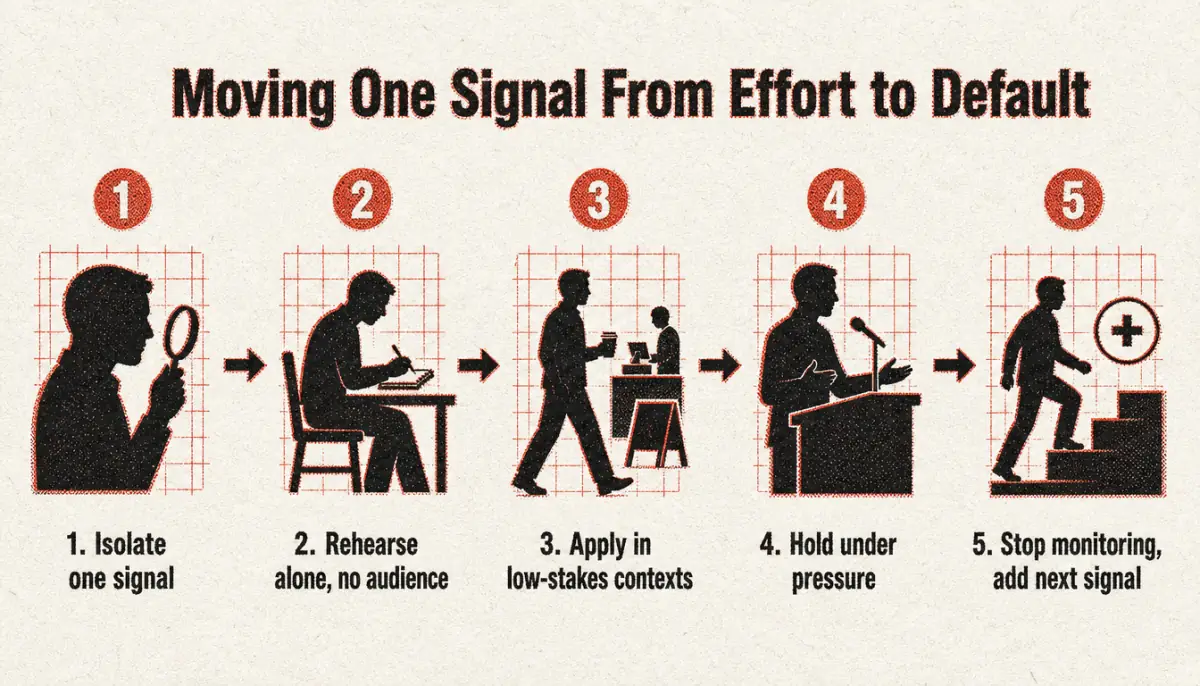
Two rules apply regardless of entry point. Work one signal at a time, because conscious attention split across four behaviors produces the stiffness you’re trying to eliminate. And expect the first two weeks of any change to feel artificial, since you’re overriding a pattern your body treats as normal. That artificial feeling is not evidence the signal is wrong. It’s evidence the old pattern was automatic.
The sequence below shows how to move a single signal from conscious effort to genuine default.
Why Dominance Displays Backfire
The advice that dominates this topic, the power pose, the crushing handshake, the deliberate space invasion, shares a hidden assumption: that presence is about winning a contest for status. That assumption produces men who are exhausting to be around and, more to the point, easy to read.
Consider what a dominance display requires. Constant monitoring of relative position. Continuous effort. A reference point outside yourself. A man performing dominance is by definition preoccupied with how he compares, which is the opposite of the settled state he’s trying to signal. Dominance is a claim about others. Groundedness is a fact about you.
This is where Stoic practice becomes practical rather than decorative. The distinction between what is within your control and what is not maps directly onto body language. Your posture, your breath, your speed, your capacity to sit still under observation, all within your control. How a given person reads you, whether they respect you, whether they yield social space, none of it within your control. Every technique aimed at the second category requires you to monitor results, and the monitoring itself leaks.
The practical version is a redirection of attention. Instead of tracking how you’re being received, hold the standard you set for how you carry yourself and let the reception fall where it falls. Marcus Aurelius wrote extensively about acting according to your own nature without regard for applause. Applied to physical presence, this means your posture is correct because you decided it should be, not because it’s working on anyone.
There’s a testable difference between the two approaches. Dominance techniques degrade when nobody is watching, because they have no purpose without an audience. Grounded signals hold in an empty room. If your posture changes when you enter your own house alone, you’ve been performing. If it doesn’t, you’ve built something.
Common Mistakes Men Make When Working on Presence
Four patterns account for most failed attempts at this work.
Stacking too many signals at once
A man reads a list of twelve behaviors and attempts all twelve on Monday. The result is a body running a dozen conscious subroutines, which looks exactly like what it is. One signal, two to three weeks, then the next. Slower in theory, faster in practice.
Mistaking tension for strength
The instinct when trying to appear solid is to tighten. Squared shoulders become pinched shoulder blades, steady gaze becomes an unblinking stare, stillness becomes a freeze. Grounded presence is a release of tension, not an addition of it. If a signal requires muscular effort to hold, you’re doing a different thing than the one described.
Treating it as a social tool rather than a physical practice
Men who approach this as a communication hack practice it only in social settings, where they’re also managing conversation content and their own nerves. The reps have to happen elsewhere: alone, in transit, while working, during training. Presence built only in front of others is presence that requires others.
Ignoring the physical substrate
Posture is a function of muscle length, strength, and mobility. A man with chronically shortened hip flexors and a weak posterior chain cannot hold a stacked spine through willpower, and after a few weeks of trying he concludes the advice doesn’t work. Strength training, mobility work, and adequate sleep do more for body language for men than any technique, because they change the material you’re working with rather than the arrangement.
Each of these mistakes has the same structure. The man treats presence as information to apply rather than a capacity to build, which is the same error that made the motivational content he consumed earlier feel hollow. Knowing the signal is not the same as owning it.
Summary and How to Start
The three signals that carry the most weight remain stillness under attention, a stacked spine with evenly distributed weight, and slowed transitions. If you implement nothing else from this list, those three change how you’re read within a month.
The principles worth keeping:
- Subtract before you add. Every signal here removes something: a fidget, a slump, a rush, a tension. None of them asks you to perform more.
- Aggression and groundedness differ by tension, not behavior. The same eye contact, the same posture, the same silence reads as either presence or threat depending entirely on whether your jaw, shoulders, and hands are loose.
- Breath is upstream of most of it. Shallow chest breathing produces the darting eyes, the rushed speech, and the restless hands. Correct the breath and several signals correct themselves without direct attention.
- One signal at a time, two to three weeks each. Conscious attention distributed across multiple behaviors produces the stiffness you’re trying to eliminate.
- Train it alone. A signal that only appears in front of an audience is a performance. Practice it in an empty room, in the car, at the gym, until it holds when nobody is measuring.
- The physical substrate is not optional. Strength, mobility, and sleep determine what postures are available to you. Technique applied to a deconditioned body fails and then gets blamed on the technique.
- Judge by your own standard, not by reception. Monitoring how you’re landing keeps your attention outside yourself, and that split attention is itself visible.
Pick one signal from the table that matches your actual failure pattern. Work it for three weeks in contexts where nothing is at stake. Then add the next. Twelve signals at that pace takes most of a year, which is the correct timeline for changing something your body has been doing without your input for two decades.